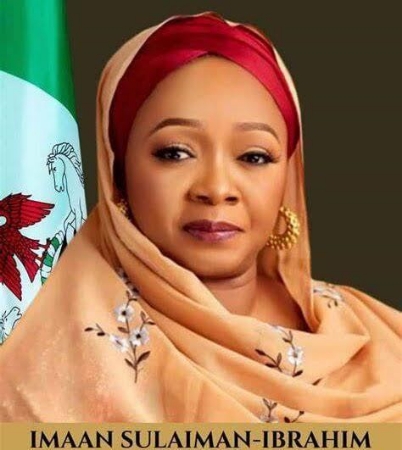
The Minister of Women Affairs and Social Development, Imaan Sulaiman-Ibrahim, has declared that women’s political leadership is no longer merely a question of fairness, but a matter of national competence, as she called for urgent reforms to increase women’s participation in governance across West Africa.
Sulaiman-Ibrahim made the statement recently in Abuja, while addressing the High-Level Women’s Political Leadership Forum, convened by the ECOWAS Commission, the Nigerian Government, the African Union, the African Women Leaders Network and the United Nations Development Programme (UNDP).
The forum, held under the theme, “Accelerating Women’s Political Participation and Leadership in West Africa: From Commitment to Action,” brought together political leaders, parliamentarians, government officials, women’s networks and development partners to address the persistent barriers limiting women’s access to political power.
“Women’s political leadership is no longer a matter of fairness to women. For me, it is a matter of competence for nations. This is because a democracy that governs with half its talent is not simply unjust. It is underperforming,” the Minister said.
She stressed that Africa does not lack women with the capacity, ambition and commitment to lead, but continues to struggle with political and institutional structures that make it difficult for women to enter and remain in leadership.
“Africa does not suffer from a shortage of capable women. It suffers from structures that were never built to let them through,” Sulaiman-Ibrahim said.
Her remarks came against the backdrop of persistent gender disparity in political representation across the region. Women currently hold 18.4 per cent of parliamentary seats in West Africa, the lowest share of any region on the continent, while their representation in executive positions and political party leadership remains even lower.
The Minister said Nigeria’s own experience demonstrates the gap between women’s competence and their political representation. According to her, women lead 11 of Nigeria’s 24 commercial banks, occupy about one-third of superior court positions and hold more than 30 per cent of senior positions in the Federal Civil Service, yet account for less than five per cent of elected offices.
“Where competence is the measure, she rises. Where the cost of entry and structural barriers stand in the way, too many are held back. Our challenge is not the candidate. It is the pathway,” she said.
To change that pathway, Sulaiman-Ibrahim proposed a five-point roadmap, including the establishment of a Women’s Political Leadership Trust Fund to help credible female candidates overcome financial barriers such as nomination fees, campaign costs and leadership development.
She also called for Nigeria and other West African countries to strengthen affirmative-action measures, reform political party structures and establish stronger networks connecting women in elective and appointive positions.
Another proposal was a Regional Women’s Leadership Academy to identify, mentor and prepare women from ward and local government levels for higher political office.
The Abuja forum subsequently produced the Abuja Regional Action Agenda, which sets out concrete commitments on political financing, women’s safety, mentorship, cross-party networks, youth participation and accountability. West African leaders have also committed to progressively working towards full gender parity in elective positions by 2035.
For Nigeria, the push comes as political actors and civil society organisations increasingly turn their attention towards the 2027 elections.
The challenge, however, is whether the renewed commitments will translate into more women securing party tickets, accessing campaign financing and winning elections.
“History is not made by those who gather to discuss change. It is made by those who summon the courage to institutionalise it,” Sulaiman-Ibrahim stressed.