Liberia has recorded a 44 per cent increase in the number of women occupying leadership positions across six counties, with the number rising from 66 to 95, in what development partners say demonstrates the impact of sustained investment in women’s political participation and local governance.
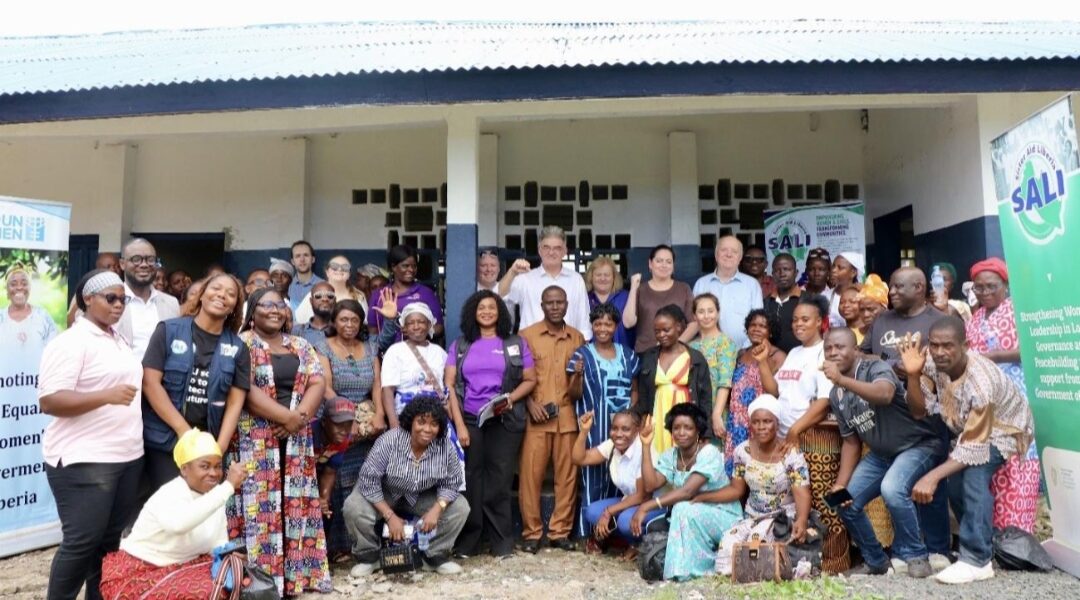
The progress was highlighted at a national dialogue on women’s leadership and local governance in Liberia, where stakeholders reviewed the achievements of the Strengthening Women’s Leadership in Local Governance and Peacebuilding Project, implemented by UN Women Liberia with support from the Government of Ireland.
According to data presented at the dialogue, the number of women serving in leadership positions across the six project counties increased from 66 in 2021 to 95, representing a 44 per cent rise. The programme has supported women leaders, members of Peace Huts, the Women in Peacebuilding Network (WIPNET), women-led civil society organisations and local authorities.
The development is particularly significant because Liberia, despite its history of electing Africa’s first female president, continues to face considerable gaps in women’s representation at different levels of governance.
At the national level, women currently account for 42.1 per cent of ministers, with eight women among 19 ministers. However, their representation falls considerably at other levels, with women occupying about 12 per cent of appointed local government positions and only eight per cent of chieftaincy positions.
The progress recorded at local level therefore provides an important example of how sustained investment, mentorship and community engagement can create pathways for women to enter decision-making spaces.
One beneficiary of the initiative is Nancy Bryant, a civil society leader in Grand Bassa County who successfully contested for the position of County Council Chairperson.
UN Women reported that women in leadership positions in Grand Bassa increased from 12 to 18, representing a 50 per cent increase. Women now occupy 56 per cent of County Council seats and half of the city mayoral positions in the county.
The programme has also sought to address one of the less visible barriers to women’s leadership: resistance from men and traditional authorities.
Isaac B. Williams, a District Commissioner and participant in the programme’s Positive Masculinity Training, described how his understanding of women’s leadership changed through the initiative.
“We believed that men were the roosters of society. We did not consider women during gatherings. If they raised their hands to speak, we denied them the opportunity,” Williams said.
He said the training challenged those beliefs and encouraged him to become an advocate for women’s participation in decision-making.
The initiative has also connected women’s leadership with peacebuilding. Since its launch in 2021, the project has reached nearly 1,590 people, while Peace Hut members have helped mediate more than 58 cases, including land disputes, domestic violence, child-support disputes, leadership conflicts and election-related tensions.
Esther Davis Yango, Executive Director of the Women NGO Secretariat of Liberia (WONGOSOL), and Miatta Darwolor, Executive Director of Sister Aid Liberia, have been among the civil society leaders involved in implementing and strengthening the programme.
During a June 2026 visit by an Irish parliamentary delegation to Grand Bassa, stakeholders witnessed how investments in women’s leadership were translating into greater participation in local governance and community peacebuilding.
Cathy Bennett TD, a member of the Irish delegation, stressed the importance of men becoming allies in the campaign for gender equality.
“Men must continue stepping up to support women in their leadership roles and contribute to creating a more equal society,” she said.
However, stakeholders say the gains must be sustained.
The increase from 66 to 95 women leaders represents progress, but it also highlights the distance Liberia still has to travel before women achieve equal representation across political, traditional and local governance structures.
For Liberia, the emerging lesson is that increasing women’s representation requires more than encouraging women to contest elections. It requires mentorship, community support, male allies, leadership training, access to decision-making structures and sustained investment.
The experience also offers a possible lesson for other African countries, including Nigeria, where women remain significantly underrepresented in elected political positions.
Liberia’s 44 per cent increase therefore represents more than a statistic. It is evidence that when women are deliberately prepared, supported and given opportunities to lead, local governance can begin to look different—and communities can benefit from their participation.