
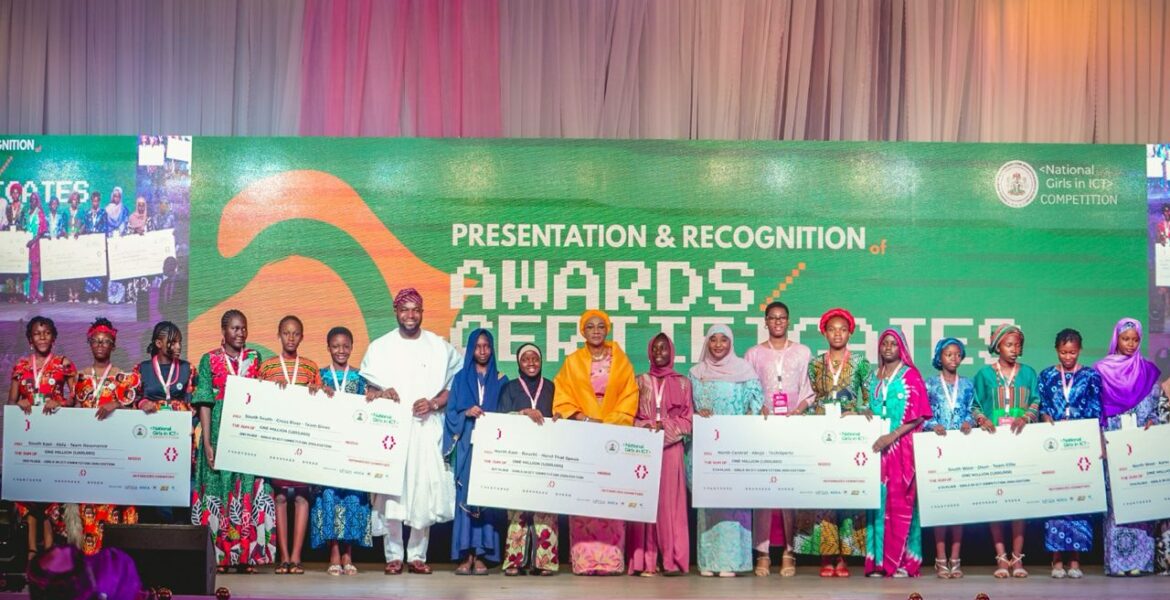
A total of 111 girls have emerged as winners from over 3,700 participants in the 2026 National Girls in ICT Competition, taking a major step into Nigeria’s technology and innovation space.
The competition was organised by the Federal Ministry of Communications, Innovation and Digital Economy to promote digital skills and encourage more girls to pursue careers in technology and innovation.
Drawn from public secondary schools across the six geopolitical zones, who participated in the competitions, boot camps, mentorship sessions and innovation challenges designed to expose them to digital skills and encourage them to develop technology-based solutions to everyday problems.
The programme culminated in a national grand finale and a celebratory dinner in Abuja, where First Lady Oluremi Tinubu joined government officials, technology stakeholders, mentors and participants to celebrate the achievements of the young innovators. Reports by The Guardian, The Nation, Leadership and Channels Television placed the number of participants at more than 3,700.
At the final stage, six teams representing Nigeria’s six geopolitical zones presented their innovations before judges drawn from government, industry, academia and the innovation ecosystem. The projects addressed challenges in areas including healthcare, education, agriculture, accessibility and public service delivery.
The overall winner was Team Hands that Speak from the Special Education Centre, Bauchi State, representing the North-East. Its innovation, SignCare, is a digital health accessibility platform designed to improve communication between deaf patients and healthcare providers.
Team Divas from Federal Government Girls College, Cross River State, representing the South-South, came second, while Team Resonance from Resonance Science School, Abia State, representing the South-East, placed third.
Other finalists were Team FarmShield 360 from Sweet Heaven High School, Kano State, which placed fourth; Team Tech Expert from Government Science Secondary School, Abuja, which came fifth; and Team Elite from Kidvarc High School, Osun State, which finished sixth.
Speaking at the event, the Minister of Communications, Innovation and Digital Economy, Dr Bosun Tijani, said the competition had demonstrated that Nigeria has no shortage of young talent, but must ensure that opportunities to develop that talent are available across the country.
Tijani said investing in girls was both a social and economic imperative as Nigeria works to build a competitive digital economy. He also stressed the importance of ensuring that young women are able to participate fully in technology and innovation.
The First Lady challenged the girls to remain curious, confident and courageous, urging them to continue using technology to solve problems and improve the lives of people in their communities. She also commended the introduction of Code Clubs and the distribution of club kits as part of efforts to strengthen digital learning among young people.
For Women News Today, however, the significance of the competition goes beyond the celebration of 111 regional winners.
The participation of thousands of girls from across Nigeria highlights both the growing interest of young women in technology and the need for sustained investment in their skills, mentorship and access to digital opportunities. With women and girls still facing barriers to participation in many technology-related fields, programmes that expose them to innovation at an early age could help create a stronger pipeline of future female technology professionals and leaders.
The Federal Ministry said the competition, now in its fourth edition, is part of efforts to bridge the gender gap in technology and ensure that Nigeria’s digital transformation creates opportunities for young people regardless of gender or location. The programme is supported by partners including the Korea International Cooperation Agency (KOICA), the International Telecommunication Union (ITU), the National Information Technology Development Agency (NITDA) and other stakeholders.
As Nigeria continues to expand its digital economy, the achievements of the girls provide a reminder that closing the gender gap will require more than celebrating female innovators. It will also require sustained access to education, mentorship, equipment, funding and platforms through which girls can turn their ideas into viable technologies and businesses.
The 2026 National Girls in ICT Competition has therefore placed a spotlight on a new generation of Nigerian girls who are not only learning about technology, but are beginning to use it to respond to some of the country’s most pressing challenges.