…Seeks more inclusive law faculties across Nigerian universities
The University of Lagos (UNILAG) has raised concerns over the declining representation of women as they progress to senior academic and leadership positions in Nigerian law faculties.
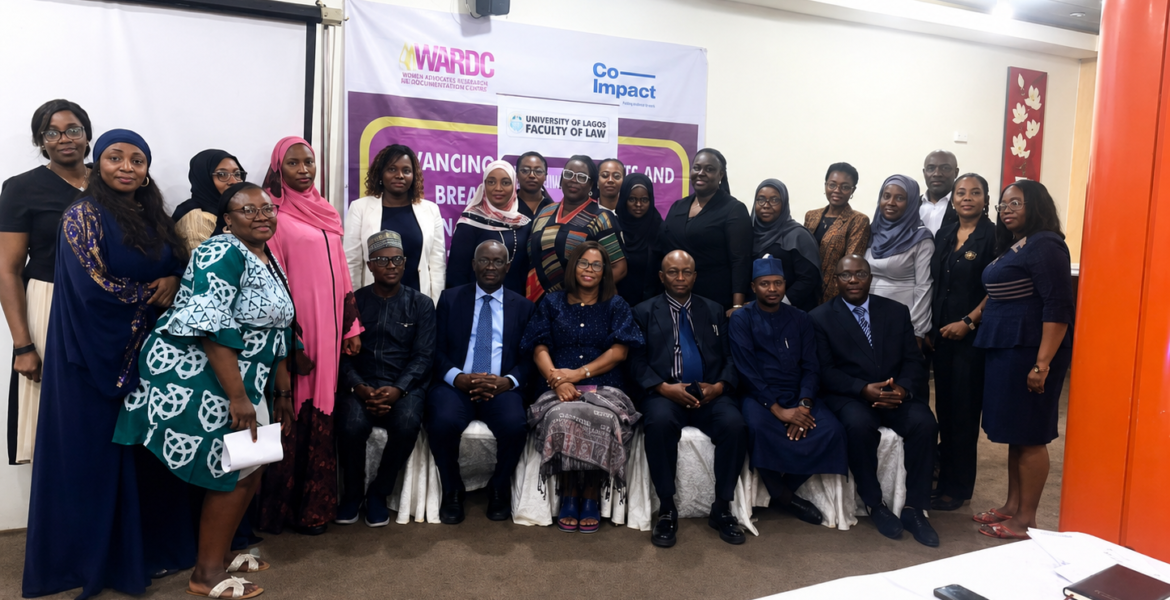
This formed the core of discussions at a research validation workshop convened in Abuja by the Faculty of Law, UNILAG, with representatives of four pilot institutions the University of Ibadan, Ahmadu Bello University (ABU), Zaria, and Bayero University, Kano (BUK), under the Advancing Women’s Rights and Breaking Barriers for an Inclusive Future for Women in Law Faculties in Nigeria (WiLAC) Initiative.
The research findings highlighted factors limiting women’s progression in legal academia, despite increasing numbers of women entering the profession. Participants at the workshop reviewed the findings and explored ways of creating a more inclusive academic environment for women.
Speaking on the research, the Dean, Faculty of Law, UNILAG, Professor Adejoke Oyewunmi, said the study was driven by the limited representation of women in legal academia, particularly in leadership positions.
She noted that although more women were entering academia, their progression was not at the same rate as that of their male colleagues in terms of promotion and access to leadership positions.
“What we found so far is that it is not for lack of competence at all,” she said.
According to her, women were already being entrusted with responsibilities within universities and law faculties, demonstrating their capacity to perform academic and administrative duties.
However, she said the disparity became more apparent when women sought promotion and advancement into leadership positions.
The UNILAG dean identified the implementation of seemingly gender-neutral institutional policies as one area requiring closer examination.
“Some of these are attributable to policies, institutional policies that on the face of it appear to be gender neutral. But when it comes to the application of the policy, the implementation of the policy, it is actually prejudicial to women,” she said.
The dean called for greater attention to the support systems surrounding women’s academic careers, urging universities, law faculties, the Ministry of Education, government and community leaders to play their roles in removing barriers to women’s advancement.
She stressed that policy reform alone would not be sufficient, noting that the interpretation and application of existing policies must also be examined.
“It’s also about the interpretation, the application of policies in a way that ensures that everybody has access, that women are not excluded, women are not disenfranchised, their own peculiarities are taken into consideration,” Oyewunmi said.
Also speaking, the President of the Nigerian Association of Law Teachers (NALT), Prof. John Oluwole Aketayo, said the changing demographics of legal education made it necessary for universities to prepare for a future in which women would constitute an increasingly significant proportion of legal academics.
He noted that female students were already recording strong performances in law faculties and at the Nigerian Law School, making it difficult to attribute the low number of women in senior academic positions to a lack of competence.
“If we have to retain the female law academics, we have to put in place measures to make sure that they have a conducive environment in which to do their job,” Aketayo said.
He advocated practical measures such as workplace crèches and accommodation arrangements that take into account the pressures faced by academics raising young children.
Meanwhile, the Dean, Faculty of Law, University of Ibadan, Prof. Kunle Aina, said he did not believe women faced institutional discrimination at the university, noting that women had occupied senior leadership positions at the university, including Dean of the Faculty of Law and Deputy Vice-Chancellor.
He however urged other universities to adopt transparent and gender-neutral recruitment and promotion processes.
“For me, women are on the same level with the men, the university’s recruitment system provided equal opportunities to qualified candidates,” Aina argued.
Earlier, Associate Professor at UNILAG, Abiola Akiyode-Afolabi, stressed the need for system change to enable more women in leadership roles at the law faculties in universities, she added that the research was seeking to understand the point at which women begin to fall out of the academic leadership pipeline.
“The field research showed that women were entering law faculties in significant numbers but experienced a “sharp drop” as they progressed through the academic hierarchy.
“What are these factors that are bringing about this drop of women within the Faculties of Law and inhibiting them from getting to that leadership level? That is one of the things that we have come to interrogate,” she said.
The research is expected to inform recommendations addressing the institutional practices, workplace structures and wider social factors that may be affecting women’s progression into senior academic and leadership positions within Nigerian law faculties.