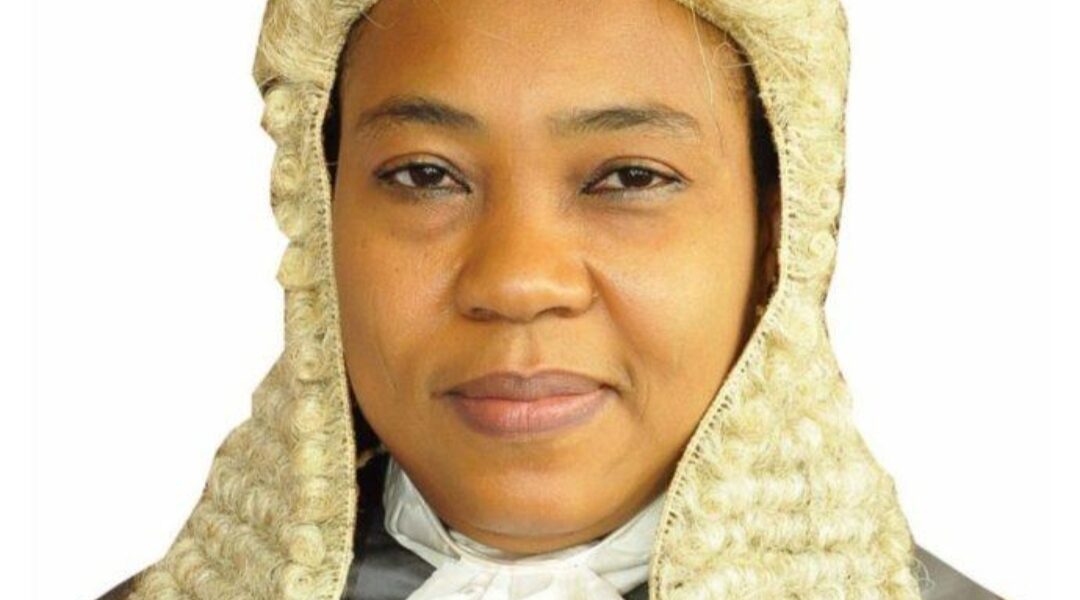
For more than three decades, Justice Dije Abdu Aboki has walked the corridors of Nigeria’s justice system, rising from a young State Counsel to become the first woman to occupy the highest judicial office in Kano State.
Her appointment as the substantive Chief Judge of Kano State in August 2023 was not only a personal milestone. It was a historic moment for women in the state’s judiciary and a significant break from a tradition that had seen the office occupied by men since Kano State was created in 1967.
But for Justice Aboki, the significance of becoming the first female Chief Judge goes beyond the symbolism of breaking a gender barrier.
It is about what she does with the opportunity.
Since assuming office, she has placed emphasis on strengthening justice administration, improving the efficiency of the courts, promoting accountability within the judiciary, tackling misconduct, expanding access to justice and strengthening the capacity of judicial officers.
Two years into her tenure, her story is increasingly one of a woman using a historic position to pursue institutional reform.
A woman whose career was built in the courtroom
Born in Kano on July 10, 1964, Justice Dije Abdu Aboki’s professional journey began long before she became Chief Judge.
She attended Tudun Wada Primary School in Kano before proceeding to Government Girls College, Minna, Niger State. She later studied law at Ahmadu Bello University, Zaria, graduating with an LL.B. degree in 1983, and obtained her qualification from the Nigerian Law School in Lagos in 1984. She subsequently undertook her National Youth Service at Bayero University, Kano, between 1984 and 1985.
After completing her NYSC, she joined the Kano State Ministry of Justice as a State Counsel in 1985.
A year later, she entered the judiciary as a Magistrate.
From there, she steadily climbed the judicial ladder, becoming a Senior Magistrate and subsequently a Chief Magistrate in 1992. In 2006, she was appointed a Judge of the Kano State High Court.
Her career has also taken her beyond the courtroom into professional and institutional assignments.
She has been involved with the Nigerian Bar Association, International Bar Association, International Association of Women Judges and the International Federation of Women Lawyers (FIDA), where she served as Chairperson of the Kano Chapter and later as International Treasurer.
For Justice Aboki, the passion for law was formed early.
In an interview published before her historic appointment, she recalled that she had always wanted to occupy a position from which she could make a positive impact on society.
She said her interest in law was driven by a belief that “justice and fairness should prevail in all spheres of life.”
That philosophy has become particularly relevant to her leadership of Kano’s judiciary.
Breaking the gender barrier
In March 2023, Justice Aboki was appointed Acting Chief Judge of Kano State.
A few months later, the Kano State House of Assembly confirmed her appointment as substantive Chief Judge, making her the first woman to hold the position in the history of the state.
She was sworn in by Governor Abba Kabir Yusuf on August 7, 2023.
The appointment was particularly significant given Kano’s history.
Years earlier, Justice Aloma Mariam Mukhtar—who would eventually become Nigeria’s first female Chief Justice—had been the most senior judge in Kano but was passed over for the Chief Judge position because she was a woman. She would later become the first female Chief Justice of Nigeria.
Justice Aboki therefore stepped into an office whose history itself reflected the long struggle of women to attain the highest levels of judicial leadership.
At her swearing-in, she pledged to work towards making justice delivery more efficient and accessible, while stressing the importance of maintaining the independence of the judiciary.
Reforming justice administration
Justice Aboki inherited a judiciary facing the familiar challenges confronting courts across Nigeria: growing caseloads, delays, infrastructure deficits and the need to strengthen public confidence.
Her response has increasingly centred on institutional reforms rather than merely administrative management.
Tackling case backlog and delays
One of the most visible challenges confronting the justice system is the time it takes for cases to be concluded.
The scale of Kano’s caseload became clear during the 2023–2024 legal year, when Justice Aboki disclosed that the judiciary had disposed of 71,914 cases out of 102,234 cases filed during the 2022–2023 legal year.
The figure included criminal and civil cases before the High Court, Magistrates’ Courts and Shari’a Courts, with 30,320 cases remaining pending at the time.
The Chief Judge linked some of the delays to inadequate and deplorable court facilities, while welcoming efforts to complete abandoned court projects in Kano.
The figures demonstrate the enormous volume of work facing the state’s judiciary—and the importance of the reforms being pursued under her leadership.
Putting accountability at the centre
Justice Aboki has also demonstrated a willingness to confront misconduct within the institution she leads.
In February 2025, the Kano State Judicial Service Commission, under her chairmanship, took disciplinary action against a registrar of the Upper Shari’a Court in Gwarzo after an investigation into allegations of bribery.
The registrar and a court watchman admitted receiving a combined ₦214,000 in bribes, according to the commission’s findings. The registrar was demoted and compulsorily retired, while the watchman’s appointment was terminated.
The commission continued its disciplinary drive.
In July 2026, under Justice Aboki’s chairmanship, the Judicial Service Commission compulsorily retired two judicial officials, demoted a Shari’a Court judge, suspended a court clerk without pay and ordered further investigations into other cases of alleged misconduct.
These actions have sent a strong message about professional conduct within the judiciary: judicial authority comes with accountability.
The Independent Corrupt Practices and Other Related Offences Commission (ICPC) also publicly acknowledged the importance of collaboration with the Kano judiciary in strengthening the fight against corruption. During a 2025 visit to Justice Aboki, the commission’s representative stressed the importance of judicial support in its anti-corruption work, while the Chief Judge expressed readiness to collaborate with the agency.
Strengthening the judiciary with new judges
Justice Aboki’s administration has also sought to address the demands on the judicial system by strengthening its human resources.
In April 2026, she swore in 30 newly appointed Shari’a Court judges, urging them to discharge their responsibilities with integrity, impartiality and accountability.
She reminded the new judges of the need to uphold justice, fairness and the rule of law.
The appointments are significant in a state where the Shari’a court system handles a substantial volume of cases.
Beyond increasing manpower, however, Justice Aboki has consistently emphasised the ethical responsibilities that accompany judicial office.
Giving awaiting-trial inmates another chance
Perhaps one of the most human-facing aspects of her judicial leadership has been her intervention in cases involving people held in custody while awaiting trial.
In August 2026, Justice Aboki reviewed 82 awaiting-trial cases at the Kurmawa and Goron Dutse custodial centres in Kano.
Following the review, she ordered the release of seven inmates, taking their health conditions and circumstances into consideration.
The exercise was aimed at promoting speedy justice, reducing prolonged detention and protecting the rights of people in custody.
For the individuals released, the intervention was more than a judicial statistic.
It meant freedom.
It also illustrated the human dimension of justice administration: that behind every case file is a person whose liberty, family and future may depend on how efficiently the justice system works.
Promoting alternative dispute resolution
Justice Aboki has also supported efforts to expand the ways in which disputes can be resolved.
Her administration inaugurated the Kano Multi-Door Courthouse and introduced a Practice Direction on Restorative Justice, aimed at providing alternative pathways for resolving appropriate disputes and reducing pressure on conventional courts.
The approach is significant because it recognises that not every dispute needs to follow the longest and most adversarial route through the traditional court system.
Alternative dispute resolution can help parties settle appropriate matters more quickly while freeing judicial time for cases that require full adjudication.
Modernising the judiciary
A 2025 assessment by the League of Civil Society Organisations in Kano praised Justice Aboki’s administration for improvements in court infrastructure, financial accountability, staff welfare and digital transformation.
The coalition specifically cited renovations to judicial facilities, digitisation initiatives and reported improvements in the Probate Unit, including revenue generation of more than ₦220 million.
These figures and assessments come from a civil society commendation rather than an independent audit, but they reflect the broader public conversation around reforms under Justice Aboki’s leadership.
A woman changing the meaning of leadership
Justice Dije Abdu Aboki’s achievement is therefore not simply that she became Kano’s first female Chief Judge.
Her story is about what happens when a woman reaches the highest level of an institution after spending decades acquiring the experience required to lead it.
She entered the legal profession in the 1980s, when opportunities for women in senior positions were considerably more restricted.
She became a magistrate.
Then a Chief Magistrate.
Then a High Court Judge.
And eventually, Chief Judge.
Her journey has demonstrated that breaking a glass ceiling is only the beginning.
The greater responsibility is to use the position to improve the institution and make the path wider for those who come after.
For young women watching her career, her rise sends a powerful message: the courtroom, the bench and the highest levels of judicial leadership are not spaces reserved for men.
Beyond being the “first”
There is a temptation to define pioneering women only by the barriers they break.
But Justice Aboki’s tenure suggests that her legacy should be measured by more than the historic nature of her appointment.
The stronger question is: What has changed because a woman is leading Kano’s judiciary?
The answers emerging from her tenure include stronger disciplinary action against misconduct, efforts to tackle case delays, expansion of judicial manpower, interventions for awaiting-trial inmates, promotion of alternative dispute resolution and efforts towards a more modern and accountable justice system.
Her administration has also continued to emphasise judicial integrity and independence.
That makes Justice Dije Abdu Aboki’s story particularly relevant to the mission of Women News Today.
Her story is not simply about a woman who reached the top.
It is about a woman who reached the top of a powerful institution—and is using that position to influence how justice is administered.
A legacy still being written
Justice Aboki’s tenure is still unfolding.
There will inevitably be challenges ahead: case backlogs, infrastructure needs, public expectations, judicial independence and the continuing demand for greater access to justice.
But her journey has already secured her a place in Kano’s history.
She is the state’s first female Chief Judge.
She is also a jurist whose career has stretched across more than four decades of Nigeria’s justice system.
And perhaps the most important lesson from her story is that representation becomes most meaningful when it is accompanied by competence, accountability and a commitment to institutional change.
Justice Dije Abdu Aboki has broken the barrier.
Now, through the reforms and choices made under her leadership, she is helping to redefine what leadership from the other side of that barrier can look like.