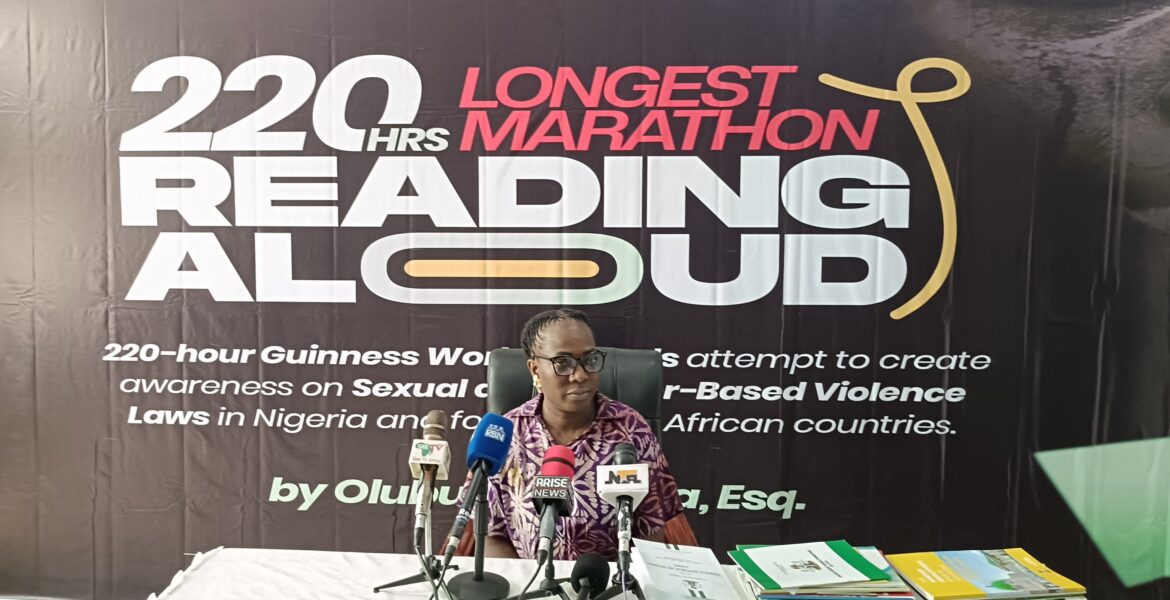
As the world prepares for the 2026 16 Days of Activism against Gender-Based Violence, a Nigerian lawyer, Barrister Olubunmi Uluba, has commenced a 220-hour continuous reading marathon to raise awareness of laws addressing gender-based violence (GBV) in Nigeria and 14 other African countries.
The Guinness World Records attempt, which began on Monday, November 9, at the Maryam Babangida National Centre for Women Development, Abuja, seeks to promote legal awareness, strengthen advocacy for survivors and draw attention to the need for effective enforcement of laws protecting women and girls.
Supported by UN Women Nigeria, the nine-day, four-hour exercise will feature public readings of relevant legal frameworks from 15 African countries, providing an opportunity to educate citizens about their rights, available legal protections and mechanisms for seeking justice.
Speaking at the commencement, UN Women Country Representative, Beatrice Eyong, described the initiative as an innovative approach to addressing the knowledge gap surrounding GBV laws, noting that ignorance of existing protections affects both survivors and institutions responsible for enforcing them.
She stressed that gender-based violence was not exclusively a women’s issue but a development challenge with far-reaching consequences for families, communities and national economies.
“One of the greatest obstacles is the gap between the laws that exist and public knowledge of those protections. Sometimes the duty bearers don’t know about these laws, and sometimes the rights owners don’t know about these laws. You cannot enforce any law that you actually don’t know about,” Eyong said.
She explained that practices such as child and early marriage also perpetuate poverty by depriving girls of education, vocational training and economic opportunities.
According to her, the ultimate achievement of the marathon should go beyond securing a Guinness World Records recognition to reaching millions of people with information that could help prevent violence and improve access to justice.
Representing the Attorney-General of the Federation, Lateef Fagbemi, the Head of the Sexual and Gender-Based Violence Response Unit of the Federal Ministry of Justice, Yewande Gbola-Awopetu, said legislation alone could not eliminate GBV without sustained public education, effective institutional responses and accountability.
She emphasised that every survivor deserved to be heard, protected and treated with dignity, while perpetrators must be held accountable.
The initiative also drew attention to the experiences of women with disabilities. Founder of the Network of Women with Disabilities, Lois Auta, highlighted barriers confronting survivors with disabilities, including inaccessible police stations, inadequate sign language interpretation and exclusionary court procedures.
She called on government to domesticate, adequately fund and enforce protective laws, stressing that women with disabilities must be included in decisions affecting their rights and protection.
Similarly, the International Federation of Women Lawyers (FIDA), Abuja Branch, represented by its Publicity Secretary, Chimdindu Onyedim-Etuwewe, commended the initiative, describing it as an opportunity to promote legal awareness while encouraging critical examination and reform of outdated laws.
Uluba commenced the marathon with Chapter Four of Nigeria’s 1999 Constitution, which addresses fundamental rights, beginning with Section 33 on the right to life.
Other Nigerian legislation scheduled for the exercise includes the Violence Against Persons (Prohibition) Act, 2015, the Child Rights Act and the Discrimination Against Persons with Disabilities (Prohibition) Act, 2018.
The 14 other countries whose legal frameworks will feature include Ghana, Kenya, South Africa, Rwanda, Uganda, Tanzania, Ethiopia, Senegal, Liberia, Namibia, Botswana, Zambia, Zimbabwe and Sierra Leone.
The initiative seeks to reinforce the message that legal protections must be widely understood, effectively implemented and accessible to every woman and girl, particularly survivors who face additional barriers to justice.