At 16, Dr Ifeoma Charles-Monwuba was preparing to leave secondary school and pursue her dream of university education when a proposed marriage threatened to redirect her life before she had the opportunity to decide what she wanted.
Her father’s business was struggling, and prospective business partners offered to provide the capital he needed on one condition: that his daughter marry a younger brother in their family.
The proposal placed the teenager’s future against the backdrop of financial hardship, cultural expectations and the belief that marriage should take precedence over a girl’s education.
But her father refused to exchange her future for financial support.
“I have made up my mind she is going to the university,” Charles-Monwuba recalled her father telling the men who proposed the arrangement.
That decision became a defining moment in her life, shaping a career that would eventually take her from Nigeria’s private sector into international development, public health, governance and infrastructure programmes across several African countries and beyond.
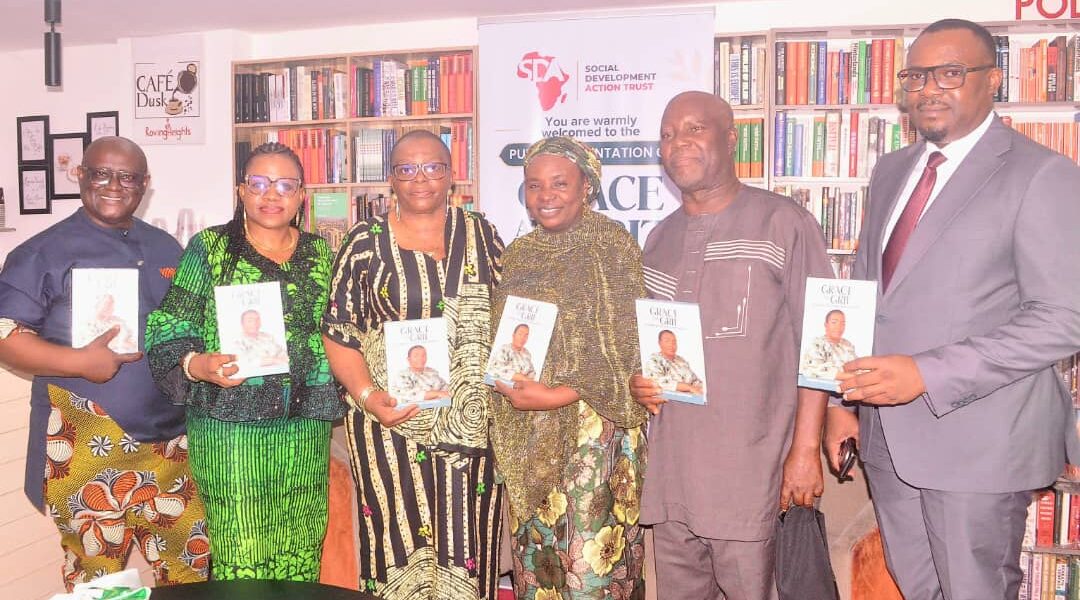
Decades later, Charles-Monwuba has documented that experience, alongside the personal and professional challenges that shaped her journey, in her memoir, Grace and Grit, presented publicly by the Social Development Action Trust (SDA Trust) as part of activities marking the 2026 International Day of the Girl Child.
The event, held against the backdrop of this year’s focus on ending child marriage, brought together development practitioners, advocates, journalists and other stakeholders to examine how family decisions, social norms, poverty, inadequate educational infrastructure and insecurity continue to influence the lives of girls in Nigeria.
Beyond celebrating one woman’s achievements, the discussion raised a fundamental question: how many girls are denied the opportunity to determine their futures because their families and communities consider early marriage a more acceptable option than continued education?
When poverty and tradition compete with a girl’s future
For Charles-Monwuba, the possibility of child marriage was not an abstract social problem. It was an experience that could have altered the entire course of her life.
In a reading from her memoir, she recounted how her father’s business partners proposed marrying her off as a condition for investing in his business.
She said she was stunned that such a consequential decision could be discussed without first asking for her opinion.
“No one had asked what I wanted. It was as though my life could be decided over a few sentences and an exchange of money,” she recalled.
Her father rejected the arrangement despite the financial difficulties facing his business, insisting that she should proceed to university.
The experience exposed the vulnerability of girls whose futures are determined by adults, particularly when financial pressures intersect with cultural expectations surrounding marriage.
Charles-Monwuba’s story also illustrates the importance of parental support in challenging practices that limit girls’ choices.
Although her father initially protected her from the proposed marriage, she later faced pressure from family members to accept other suitors. Her experience at university, where she encountered young women pursuing their ambitions, strengthened her resolve to postpone marriage and build a career.
She eventually married and had children while pursuing professional opportunities, demonstrating that education and career development do not necessarily conflict with family life.
Speaking at the presentation, she said the memoir was inspired by a period of reflection on her career and the lessons she had gathered over more than three decades of professional experience.
“I felt I needed to give back,” she said, explaining that she wanted to document her lived experiences for young people seeking direction and for parents making decisions on behalf of their children.
Her message to parents was direct: “Be intentional about the life of your children, be intentional about what you say to them, be intentional about how you help them to succeed.”
Beyond parental attitudes: The structural barriers keeping girls out of school
While the author’s experience demonstrates the difference a supportive parent can make, stakeholders at the presentation cautioned against treating child marriage solely as a problem of individual family decisions.
Amina Baba-Manu, Director of Strategy, Innovation and Impact at SDA Trust, said early marriage was sustained by a combination of cultural beliefs, economic hardship, inadequate educational infrastructure and concerns about girls’ safety.
She explained that some communities marry off their daughters because they fear the girls may become pregnant outside marriage or bring what the families perceive as shame.
However, she argued that these social expectations cannot be separated from the practical challenges families face in accessing education.
Baba-Manu recalled an interaction with parents in a community in Sokoto, where families described the difficulties of sending their daughters to secondary school because of the distance involved.
According to her account, the nearest senior secondary school was approximately two hours away on foot, raising concerns about the safety of girls travelling to and from school.
For such families, the absence of nearby schools can make continued education appear impractical, particularly where parents have limited resources and are already anxious about insecurity.
The problem, she said, demonstrates how child marriage can emerge from the interaction of several disadvantages rather than from a single cultural practice.
“We have policies. We have the laws in place. But it’s just the implementation of those policies,” Baba-Manu said, calling for stronger implementation of existing commitments alongside community engagement.
She stressed that interventions aimed at changing attitudes would have limited impact if governments failed to provide accessible schools, qualified teachers and safe learning environments.
Parents, communities, civil society organisations and public institutions must therefore work together to create conditions in which girls can remain in school and complete their education.
The cycle of poverty and early marriage
Baba-Manu also highlighted the economic consequences of early marriage, particularly where girls are withdrawn from school because their families cannot afford the costs of education.
She said families in some communities identify poverty as a reason for marrying off their daughters, even though the resulting marriages may not provide lasting economic security.
In cases where marriages break down, young women may return to their families with children and additional financial responsibilities, perpetuating the hardship that contributed to their early marriage in the first place.
The result is a cycle in which limited access to education restricts economic opportunities, while financial dependence further reduces women’s ability to make decisions about their lives.
For Baba-Manu, educating girls is therefore not simply a matter of individual advancement. It is also an investment in families, communities and the wider economy.
She noted that girls who receive an education are better positioned to contribute to society and support the education of the next generation.
Her argument challenges the assumption that marrying off a daughter early is a reliable response to poverty. Without access to education and meaningful economic opportunities, such decisions may deepen rather than resolve household vulnerability.
The challenge for policymakers is to address the conditions that make early marriage appear attractive or unavoidable to some families, while ensuring that girls are not denied their right to education.
Why fathers must become champions of girls’ rights
The role of fathers emerged as one of the central themes of the presentation, with stakeholders urging men to use their influence to protect girls’ rights and support their education.
The Country Director of Plan International Nigeria, Dr Charles Usie, described Charles-Monwuba’s father as a pivotal figure in the memoir because he refused to allow financial pressure and social expectations to determine his daughter’s future.
He said the outcome of that decision demonstrated that educating girls does not prevent them from becoming wives, mothers or productive members of society.
Instead, he argued, education expands their choices and strengthens their capacity to contribute to their families and communities.
“What role are you playing in the life of girls? Either your daughter, your sister, your friend, what role are you playing? Are you enabling this problem or are you part of the solution?” Usie asked.
He identified himself as a feminist and a champion of girls’ rights, arguing that men have considerable influence over whether girls are protected, educated and allowed to determine their futures.
Usie said Plan International had supported fathers’ support groups in states including Sokoto and Bauchi, bringing men together to promote girls’ protection and ensure they complete school before marriage.
He called for the approach to be expanded across Nigeria, urging fathers to become advocates for girls rather than participants in practices that restrict their opportunities.
His position reinforces a key lesson from Grace and Grit: progress towards ending child marriage requires more than asking girls to be ambitious. It also requires adults, particularly those who exercise decision-making power within families and communities, to support those ambitions.
Schools must be accessible, safe and conducive to learning
For Charles-Monwuba, parental commitment must be matched by public investment in education.
She argued that it was unreasonable to expect parents to send their daughters to school when the journey was unsafe or when the facilities available could not provide an adequate learning environment.
“Making young girls to traverse long distances to find school is not safe for them,” she said, urging authorities to ensure that schools are located within reasonable reach of the communities they serve.
She also called for adequate sanitary facilities and conducive learning environments, noting that these are essential to girls’ participation and educational outcomes.
Security was another major concern. The author said parents must be confident that their children can travel to school, learn and return home without being exposed to kidnapping or other threats.
In communities affected by insecurity, fear can become another barrier to education, leaving girls vulnerable to withdrawal from school and early marriage.
Charles-Monwuba also pointed to alternative learning approaches, including online education, while stressing that such options require devices, reliable network coverage, infrastructure and qualified teachers.
Her argument places responsibility on government to move beyond policy declarations and provide the practical conditions required for girls to exercise their right to education.
Laws must translate into protection for girls
The discussion also highlighted the gap between legal commitments and implementation.
Charles-Monwuba called on states to adopt and enforce the legal protections intended to prevent child marriage before the age of 18.
Nigeria’s constitutional and statutory framework governing marriage and children’s rights is complex, and the applicable protections and enforcement mechanisms vary across legal contexts. This makes it important for authorities to ensure that relevant laws are harmonised, implemented and understood by communities.
For advocates, the existence of laws is not enough if families remain unaware of their obligations, public institutions fail to enforce protections or girls cannot access the education and support needed to remain in school.
Baba-Manu similarly argued that community-based interventions must be supported by government action, including the provision of schools and teachers and the effective implementation of existing policies.
The stakeholders’ position was that ending child marriage requires a coordinated response that combines legal protection, public investment, social mobilisation and support for families facing economic hardship.
A memoir as a tool for social change
For Charles-Monwuba, the decision to publish Grace and Grit was also an attempt to make her professional and personal experiences useful to people who may be navigating similar challenges.
A development specialist with more than three decades of experience, she has worked across the private sector and international development, including roles with the Society for Family Health, WaterAid Nigeria, ActionAid and the United Nations Office for Project Services.
Her career has included leadership responsibilities in Nigeria, Haiti, Senegal and other West African countries, as well as work involving infrastructure, public health, governance and development programmes.
Yet she said the book was not written simply to recount professional achievements. It was intended to show how decisions, opportunities, relationships and support systems influence the direction of a person’s life.
In an interview at the presentation, she explained that the memoir was intended for young people who might rule themselves out of ambitious careers because they lacked privileged family backgrounds.
She described herself as a first-generation graduate, saying her background had not included a long line of professors or diplomats.
She also dedicated part of the book’s message to parents, particularly fathers, whose decisions can either expand or restrict their daughters’ opportunities.
The memoir further explores the support systems that enabled her to navigate professional responsibilities alongside motherhood and family life.
Her account challenges the notion that women must abandon their ambitions to meet cultural expectations, while acknowledging that supportive relationships are important to managing multiple responsibilities.
Turning inspiration into action
The presentation of Grace and Grit offered a personal account of what can happen when a girl is allowed to continue her education, but its wider message extends beyond one family.
The story of Charles-Monwuba’s father demonstrates the importance of parental choices. The accounts shared by SDA Trust highlight the structural barriers that prevent many girls from accessing education. Plan International Nigeria’s advocacy for fathers’ support groups points to the role men can play in changing community attitudes.
Together, these perspectives suggest that ending child marriage requires action at several levels: families must support girls’ aspirations; communities must challenge harmful social expectations; governments must provide accessible and secure schools; and relevant authorities must implement laws protecting children.
Charles-Monwuba urged girls to aspire to meaningful lives and embrace opportunities when they arise, while reminding adults that they also have a responsibility to create those opportunities.
For millions of girls whose futures remain constrained by poverty, insecurity and early marriage, inspiration alone will not be enough. They need schools they can safely attend, families that support their ambitions and institutions that uphold their rights.
The central lesson of Grace and Grit is therefore not simply that one father changed his daughter’s destiny. It is that the choices made by parents and the conditions created by society can determine whether girls are able to realise their potential.
Ending child marriage will require more families to defend girls’ futures, and more public institutions to ensure that choosing education is a realistic and safe option for every girl.