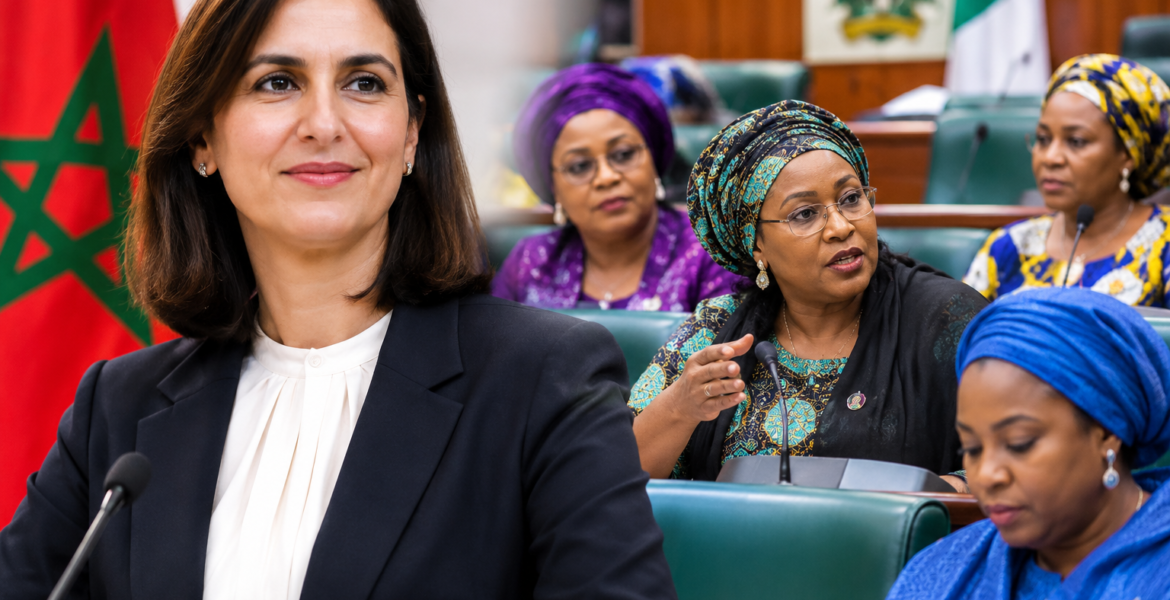
Morocco’s appointment of Fatima Ezzahra El Mansouri as its first woman Prime Minister has opened a new chapter in Africa’s long-running struggle for women’s political representation, but the historic breakthrough also raises a difficult question for the continent: when women finally reach the highest political offices, will that translate into wider and more sustainable access to power for other women?
On September 29, 2026, Morocco’s King Mohammed VI appointed El Mansouri to form a new government after her Authenticity and Modernity Party (PAM) emerged as the largest party in the September 23 parliamentary election, winning 97 of the 395 seats in the House of Representatives.
A lawyer, former housing minister and former mayor of Marrakesh, El Mansouri becomes Morocco’s first female head of government and only the second woman in the Arab world to serve as prime minister, following Tunisia’s Najla Bouden, who held the position from 2021 to 2023.
Reacting to her appointment, El Mansouri described the moment as a source of pride not only for herself but for Moroccan women.
Her emergence is significant. But across Africa, where women remain substantially under-represented in parliaments, cabinets, political parties and executive decision-making, the real significance of Morocco’s development may lie beyond the symbolism of having a woman at the top.
A breakthrough, but not yet equality
The Inter-Parliamentary Union (IPU) and UN Women reported in March 2026 that only 28 countries worldwide were led by a woman as head of state or government, while women occupied just 27.5 per cent of parliamentary seats and 22.4 per cent of cabinet positions globally.
The figures demonstrate that women’s access to political power remains far from equal.
Africa is no exception.
Morocco’s breakthrough therefore comes against a continental backdrop in which women have made important gains but remain significantly under-represented in the institutions where political decisions are made.
The question is no longer simply whether an African country can produce a woman president or prime minister. It is whether political systems can create a pipeline of women leaders at national, regional and local levels, allowing women’s participation to become institutional rather than exceptional.
For Morocco, El Mansouri’s appointment could become an important symbol of that progression.
But her appointment also comes with a broader political reality. Morocco is a constitutional monarchy in which the King retains substantial powers, including over key areas such as foreign policy and defence. El Mansouri must also build a coalition after her party won 97 seats, well short of the 198 needed for a majority in the 395-member House.
Her appointment is therefore historic, but it does not mean that Moroccan women have suddenly achieved political equality.
Nigeria’s uncomfortable comparison
For Nigeria, Morocco’s development provides an opportunity for serious reflection.
The country has never elected a woman as president or vice president, and women’s representation in the National Assembly remains extremely low.
Current IPU data show that women occupy only 15 of the 356 occupied seats in Nigeria’s House of Representatives — about 4.2 per cent.
That figure places Nigeria far below the global average.
The problem is not a shortage of qualified Nigerian women.
Nigeria has produced women who have served as ministers, governors’ deputies, legislators, ambassadors, judges, political party leaders and heads of major public institutions. Yet these individual achievements have not translated into proportional representation in elected political institutions.
And this is where Morocco’s development becomes relevant to the Nigerian conversation.
The issue is not simply whether a woman can be appointed to a powerful position. It is whether political structures are deliberately designed to make women’s leadership possible, sustainable and normal.
Nigeria already knows what needs to change
Nigeria’s women’s rights organisations, political actors and development partners have repeatedly called for structural reforms to address the gender gap.
In July 2026, ministers, parliamentarians, political party leaders and women’s networks from across West Africa gathered in Abuja for the West Africa Women’s Political Leadership Forum.
The meeting, convened by ECOWAS, the Nigerian Ministry of Women Affairs and Social Development, the African Union, the African Women Leaders Network and UNDP, adopted the Abuja Regional Action Agenda, setting out concrete and time-bound measures to accelerate women’s political participation and leadership in West Africa.
The agenda builds on the ECOWAS commitment to advancing gender parity in political representation.
The challenge, however, is implementation.
Nigeria has made several commitments to gender equality, but translating those commitments into political representation has remained difficult.
This is particularly important as Nigeria approaches the 2027 general elections.
The proposed Reserved Seats for Women Bill has emerged as one of the major responses to the problem.
The bill seeks to establish dedicated legislative seats for women as a corrective mechanism to Nigeria’s longstanding gender imbalance.
In September, the African Centre for Leadership, Strategy and Development (Centre LSD) renewed its call on the National Assembly to pass the bill, arguing that constitutional intervention is necessary to address women’s persistent under-representation in political leadership.
Centre LSD’s Founding Executive Director, Dr Otive Igbuzor, said Nigeria must adopt deliberate measures to increase women’s representation, pointing to constitutional and institutional mechanisms used by countries that have made progress in women’s political participation.
Similarly, Kafilat Adetola Ogbara, Chair of the House Committee on Women Affairs and Social Development, has argued that the Reserved Seats Bill could serve as a corrective mechanism for the political imbalance against women.
Speaking to The Guardian in September, Ogbara stressed the need for a political system in which women can compete freely, safely and fairly, while also raising the question of whether increased numbers would ultimately translate into genuine political power.
That question is crucial.
From presence to power
The experience of women in politics across Africa shows that representation and influence are not always the same thing.
A woman may occupy a political office without necessarily controlling the decisions made within that institution.
Women may also be encouraged to participate during election campaigns as voters, mobilisers and grassroots organisers, only to discover that the most influential positions are reserved for men once power is distributed.
This distinction between participation and power is one Nigeria must confront.
Women have historically played significant roles in political mobilisation. They campaign, organise communities, attend rallies, vote and often serve as the grassroots machinery of political parties.
Yet this political labour has not translated proportionately into elective office.
That imbalance becomes particularly visible during election seasons, when political parties frequently appeal to women voters while women remain under-represented among candidates and decision-makers.
The question for 2027 is therefore not simply how many women will vote.
It is:
How many women will be candidates? How many will win? How many will control party structures? And how many will sit at the table where policies and budgets are decided?
Morocco’s lesson for Nigeria
Morocco’s experience offers several lessons.
First, women need political pathways, not isolated opportunities.
El Mansouri did not emerge from nowhere. Before becoming prime minister, she had served as mayor of Marrakesh and as a government minister.
Her trajectory demonstrates the importance of allowing women to accumulate political experience at different levels of governance.
Second, political parties matter.
Women cannot enter political leadership at scale without parties opening their structures, candidacy processes and leadership positions to women.
Third, institutional reforms matter.
Where voluntary commitments have failed to produce sufficient representation, countries have increasingly turned to quotas, reserved seats and other affirmative measures.
Fourth, women’s leadership must extend beyond one office.
A single woman at the top may be historic, but sustainable political transformation requires many women occupying positions across parliaments, cabinets, political parties, local governments and policy institutions.
Africa needs more than firsts
Africa has witnessed several historic breakthroughs in women’s political leadership.
Liberia elected Ellen Johnson Sirleaf as Africa’s first democratically elected woman president in 2005. Tanzania, Ethiopia, Malawi and other African countries have subsequently seen women occupy top executive offices.
But every historic first carries a danger: that the achievement becomes celebrated as proof of progress while the structural barriers affecting millions of other women remain intact.
That is why El Mansouri’s appointment should be viewed both as a celebration and as a challenge.
Her rise demonstrates that a woman can reach the highest level of government.
But Africa must ask a bigger question:
How many women are standing behind her in the political pipeline?
How many young women are entering politics?
How many are receiving party support?
How many can finance campaigns?
How many can contest elections without facing harassment and violence?
How many women from rural communities, women with disabilities, young women and women from marginalised groups have genuine access to political power?
And perhaps most importantly, how many African political systems are prepared to see women not merely as voters and campaign mobilisers but as decision-makers?
The Nigerian opportunity
Nigeria’s political class has an opportunity to answer those questions before the 2027 elections.
The country’s extremely low representation of women in the National Assembly cannot be treated as a normal feature of democracy.
The IPU’s current figures — just 4.2 per cent women in Nigeria’s House of Representatives — provide a stark reminder of the scale of the problem.
The Abuja Regional Action Agenda provides another opportunity.
So does the Reserved Seats Bill.
But commitments and bills alone will not change the political landscape.
Political parties must change their internal structures. Campaign financing must become less exclusionary. Women candidates must be protected from political violence and harassment. Media coverage must move beyond focusing on women’s personalities, appearance and family backgrounds to examining their policies, competence and leadership records.
Most importantly, Nigerian women must be given opportunities to lead before elections, not merely mobilised during them.
A moment for Africa
Morocco’s appointment of Fatima Ezzahra El Mansouri is undoubtedly historic.
But perhaps the greatest value of her emergence is not that Morocco now has its first woman prime minister.
It is that her appointment gives Africa another opportunity to reconsider what political leadership should look like.
The continent cannot build inclusive democracies while women remain largely absent from the rooms where laws are made, budgets allocated, conflicts resolved and development priorities determined.
For Nigeria, the message is particularly urgent.
The country does not need to wait for another generation to discover that women are capable of leading.
It already knows.
What is required now is political will to dismantle the structures that continue to keep too many women outside the centre of power.
Morocco has broken one barrier.
Africa’s next challenge is to make sure that one woman’s historic breakthrough becomes a pathway for millions more.