
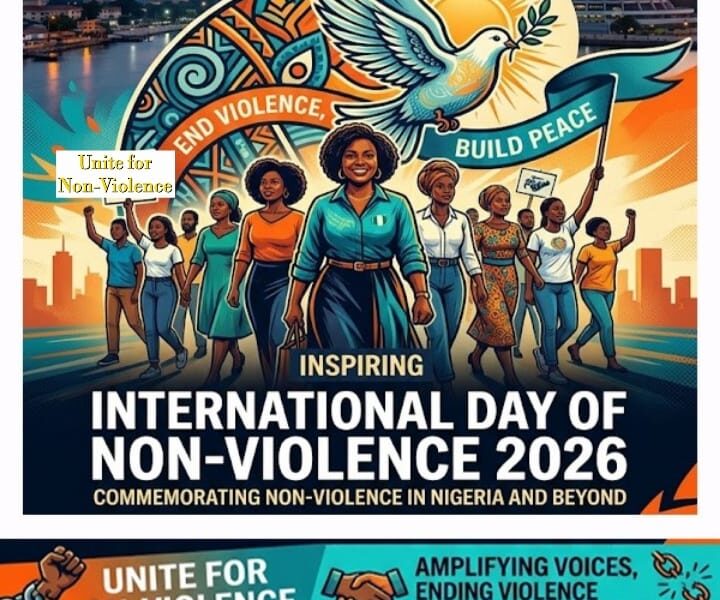
As the world marks the International Day of Non-Violence, the Women Advocates Research and Documentation Centre (WARDC) has continued to draw attention to forms of violence and preventable harm affecting women and girls in Nigeria, including unsafe abortion and technology-facilitated violence.
The United Nations marks the International Day of Non-Violence every October 2, the birthday of Mahatma Gandhi, to promote a culture of peace, tolerance, understanding and non-violence through education and public awareness.
In his message for the 2026 observance, UN Secretary-General António Guterres called for dialogue, dignity and shared humanity in confronting injustice, discrimination and oppression, saying violence should not be met by reproducing cruelty and violence.
For women and girls, the principle of non-violence extends beyond armed conflict to the violence, coercion, discrimination and denial of rights that can occur in homes, communities, health facilities and increasingly in digital spaces.
WARDC’s latest work reflects this broader concern. In its April 2026 report, The Digital Harm Effect: Confronting Technology-Facilitated Violence Against Women and Girls in Africa: A Case Study of Nigeria and Kenya, the organisation documented technology-facilitated violence as an emerging form of abuse affecting women and girls.
The report identified online harassment, surveillance, sexual exploitation, economic control and the non-consensual sharing of intimate images among the forms of digital violence experienced by women. In Nigeria, WARDC specifically highlighted WhatsApp harassment and online abuse, noting that young women, activists and journalists face particular risks.
The organisation said weak legal and institutional responses, digital illiteracy, stigma and victim-blaming can leave survivors vulnerable, and called for stronger systems to address technology-facilitated violence against women and girls.
WARDC’s latest advocacy on reproductive health also highlights another dimension of preventable harm to women and girls.
In a statement marking International Safe Abortion Day 2026, the organisation called for Nigeria to move from a primarily criminalisation-centred approach towards a clear, rights-based and medically regulated framework for safe abortion care.
WARDC argued that unsafe abortion remains a preventable contributor to maternal deaths and serious injury, particularly where women and girls are unable to obtain timely and appropriate reproductive healthcare.
The organisation placed particular emphasis on girls who become pregnant following rape or incest, arguing that survivors of sexual violence require protection, healthcare and dignity rather than additional trauma, stigma and the risk of unsafe abortion.
WARDC called for reforms that would clearly define when abortion is lawful, protect confidentiality and informed consent, regulate qualified providers and facilities, strengthen referral systems and guarantee quality post-abortion care.
It also urged the Federal Government, National Assembly, state governments and other stakeholders to prioritise legal and policy reforms, investment in the health system and accurate public information on abortion and reproductive health.
The organisation’s position is consistent with its broader mandate of promoting human rights, gender equality, accountability and social justice, while providing pro bono legal services to women experiencing gender-based violence and other rights abuses. WARDC says it has prosecuted more than 450 cases in court and established 133 paralegal communities across Nigeria.
As Nigeria joins the global observance of the International Day of Non-Violence, the experiences documented by women’s rights organisations underscore that non-violence is also about ensuring that women and girls can live free from abuse, coercion, discrimination and preventable harm.
The UN says the 2026 observance calls for societies to heal divisions through genuine dialogue and diplomacy and to build a peaceful world through non-violence.
For women and girls in Nigeria, that aspiration also raises questions about safety in homes and communities, protection from gender-based violence, access to justice and the ability to obtain essential healthcare without discrimination or coercion.