The Executive Chair of the Women Research and Documentation Centre (WARDC), Dr Abiola Akiyode-Afolabi, has expressed deep concern over Nigeria’s persistently low representation of women in leadership and decision-making spaces, stressing that the trend is fuelling poor governance outcomes, widening social inequality and stalling national development.
Dr Akiyode-Afolabi stated this in her keynote address at the 39th Annual Conference and Rally of the National Governing Body of Inner Wheel Clubs in Nigeria, titled “Step Up and Lead,” urging institutions and leaders to confront the structural and cultural barriers excluding women from power.
She noted that despite women constituting nearly half of Nigeria’s population, they occupy just 4.5 per cent of seats in the 10th National Assembly, with only 21 women out of 469 lawmakers, placing Nigeria among the lowest globally in women’s political representation and far below the 27.2 per cent global average and the 35 per cent benchmark set by Nigeria’s National Gender Policy.
Akiyode-Afolabi also raised alarm over Nigeria’s maternal health crisis, disclosing that the country accounts for nearly 20 per cent of global maternal deaths, with an estimated 512 maternal deaths per 100,000 live births, a situation she said reflects weak prioritisation of women’s lives in policy planning and resource allocation.
She further highlighted the education crisis confronting girls, noting that Nigeria has the highest number of out-of-school children in the world, estimated at 10.5 million, with over 60 per cent being girls. According to her, child marriage remains a major driver of this crisis, particularly in Northern Nigeria where 45.7 per cent of girls are married before the age of 18, often ending their education and exposing them to early pregnancy and poverty.
According to her, women are not absent from national life but are deliberately sidelined when authority is exercised. At the federal level, she said, women hold just 8 of 48 ministerial positions and 10 of 34 presidential advisory roles. At the state level, women occupy 49 of 988 seats in State Houses of Assembly, while at the grassroots, only 41 of 811 Local Government Chairperson positions are held by women nationwide.
Contrasting this with the judiciary, she observed that more transparent systems have enabled better inclusion, with 15 states currently having women as Chief Judges, and women occupying nearly one-third of seats at the Supreme Court and Court of Appeal.
Beyond politics, she noted that women dominate frontline roles in education and health but remain largely absent from top leadership positions. Only 12 of 270 Vice Chancellors in Nigerian universities are women, while in the private sector, women hold 31 per cent of board seats among the 50 most capitalised companies on the Nigerian Exchange, with just five female board chairs.
Referencing Nigeria’s Gender Audits of Elections (2007–2023), Akiyode-Afolabi said women are actively involved as voters and campaign mobilisers but are routinely excluded during party primaries where real power decisions are made. She identified patriarchal party structures, high campaign costs, political violence, intimidation and discriminatory practices as key barriers.
She also expressed concern over the increasing number of young Nigerian women engaging in irregular migration, noting that many female returnees are driven by unequal access to opportunity and leadership rather than lack of ambition.
While acknowledging the achievements of trailblazers such as Ngozi Okonjo-Iweala, Oby Ezekwesili, Ibukun Awosika, Amina Mohammed and Justice Aloma Mukhtar, she cautioned against mistaking isolated successes for systemic inclusion, stressing that thousands of capable women remain held back by poverty, culture, violence and silence.
Dr Akiyode-Afolabi called for urgent structural reforms to dismantle barriers to women’s leadership, describing inclusive governance as essential to democratic legitimacy and sustainable development.
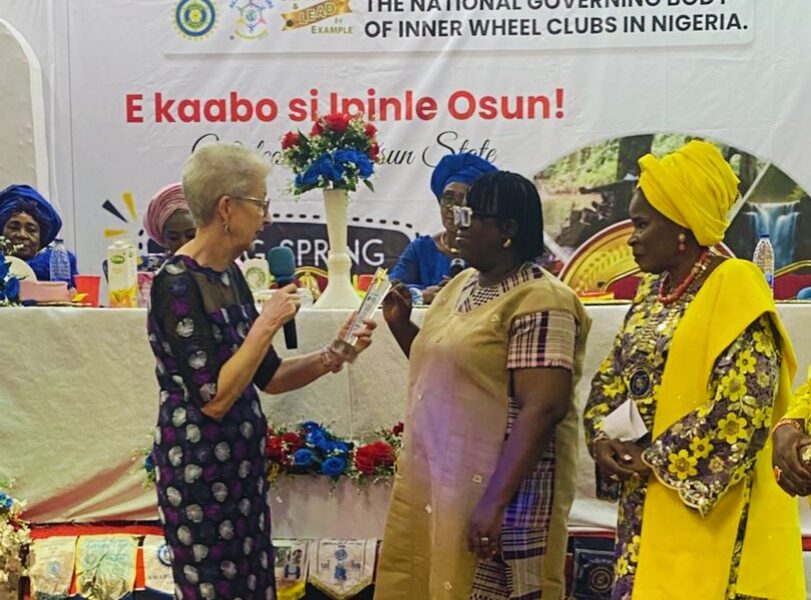
She was honoured at the event with the Award of Innovation and Gender Equality Advocate and inducted as an International Member of the Inner Wheel Club, in recognition of her long-standing commitment to gender justice and women’s empowerment.