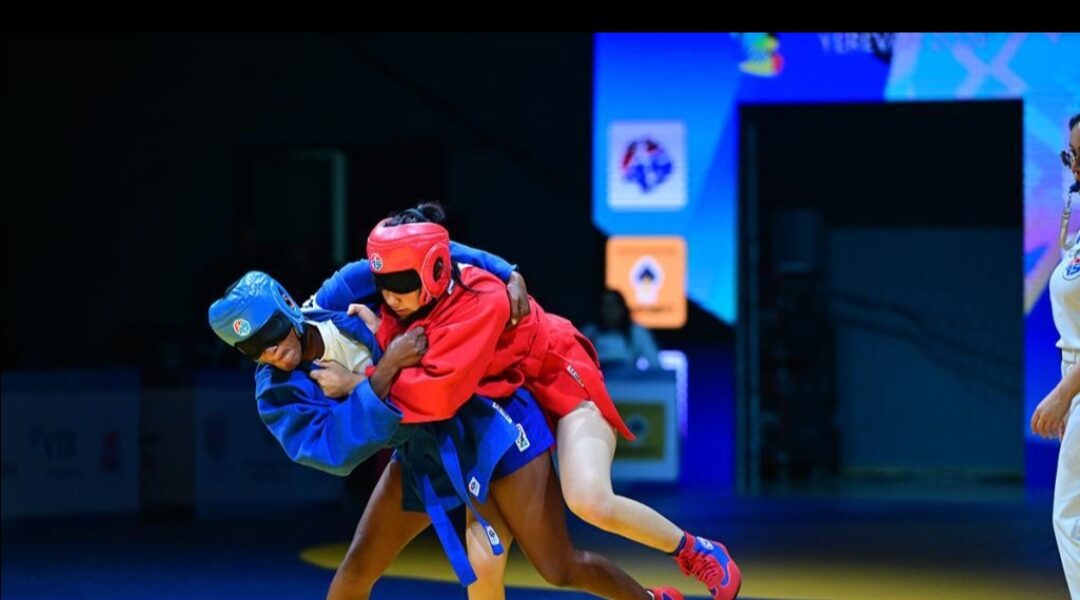
Nigerian athlete, Rukayat Taiwo Suleimon, has made history after becoming the first blind woman in the world to win a gold medal at a major international Sambo competition, following her triumph at the 2026 World Sambo Cup in Yerevan, Armenia.
Suleimon secured the historic victory in the women’s 54kg Blind Sambo category, defeating Uzbekistan’s Charos Ortikova 13–2 in the final after overcoming an early challenge in the contest.
Her victory, recorded in April, marked a significant milestone for Nigeria and Africa, as women with visual impairments competed in Blind Sambo at an International Sambo Federation (FIAS)-organised international tournament for the first time.
The Nigerian athlete had earlier defeated Kazakhstan’s Elnara Abdinazarova 12–10 in her opening bout before advancing to the final, where she produced a commanding performance to claim the gold medal.
According to the International Sambo Federation, Suleimon achieved the feat on her first appearance at an international Sambo competition, having only taken up the martial art in 2026.
Speaking about her achievement, Suleimon said she was determined not to return to Nigeria without a medal.
“I promised I would not return to Nigeria empty-handed, and I thank God I achieved my dream of winning gold. It was not easy—I was nervous in each fight since it was my first international tournament. But I conquered my fear and gave my best,” she said.
She also expressed appreciation to her coach and the Nigeria Sambo Association for their support, adding that she hoped to participate in more international competitions.
Suleimon’s journey into competitive sports followed the loss of her sight to glaucoma in 2009. She subsequently found opportunities in para-sports, initially taking part in athletics before transitioning to judo and later Sambo.
A former Lagos State judo champion, she had accumulated more than 20 national medals in athletics, including sprinting, discus and shot put, before making her international breakthrough in Sambo.
In an interview with BBC Sport Africa published in November 2026, Suleimon described her sporting achievements as evidence that visual impairment should not prevent people from pursuing their ambitions.
“If I were not blind, I don’t think I would be at this level. I believe I will achieve even more,” she said.
Her achievement also formed part of a historic outing for Nigerian women at the competition, where she and compatriot Elizabeth Aseso represented Africa among the pioneering female athletes in Blind Sambo.
Aseso competed in the women’s 59kg category but did not secure a podium finish.
Vice-President of the Nigeria Sambo Association, Sherif Hammed, described Suleimon’s victory as significant for the country and the continent, saying it demonstrated the importance of creating opportunities for visually impaired athletes to compete internationally.
He said the achievement showed that with appropriate support, Nigerian athletes could compete successfully at the highest levels of the sport.
Sambo, a combat sport with roots in Russia, combines techniques associated with wrestling and judo, including throws, holds and submission techniques. Blind Sambo is adapted for athletes with visual impairments, with competitors establishing physical contact with their opponents before bouts begin.
Suleimon’s gold medal adds to Nigeria’s growing presence in the discipline. In 2024, Samuel Oladele Kekere became the first Nigerian and African blind sambist to compete at the World Sambo Championships, while Sodiq Ajibade won bronze at the 2025 edition in Kyrgyzstan.
Her victory has also drawn attention to the participation of women with disabilities in competitive sports and the need for greater investment in accessible sporting opportunities.