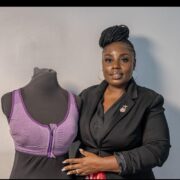

Inspired by the death of a loved one, robotics engineer and entrepreneur Kemisola Bolarinwa is developing wearable technology designed to make breast health monitoring more accessible. Her innovation reflects the growing role of Nigerian women in using science and engineering to address pressing healthcare challenges.
For Kemisola Bolarinwa, the idea of developing technology to support breast cancer detection was born out of personal loss.
In 2017, she lost her aunt to breast cancer after the disease was diagnosed at an advanced stage. During visits to the hospital, Bolarinwa encountered other women suffering from the disease, an experience that forced her to confront the consequences of delayed diagnosis and limited access to screening.
Rather than allow the experience to end with grief, she began searching for ways technology could help women identify possible signs of breast cancer earlier.
That determination led to the development of the Smart Bra Cup Diagnostic Device, a wearable technology designed to examine breast tissue for abnormalities and support early detection.
Bolarinwa, a Nigerian robotics and embedded-systems engineer and founder of Nextwear Technologies, has since attracted attention from Nigerian and international media for her efforts to bring healthcare innovation closer to women who may struggle to access conventional screening services.
Her story is one of personal determination, scientific curiosity and a desire to use locally developed technology to address a health challenge affecting women across the world.
Turning personal loss into innovation
Bolarinwa’s journey into innovation began long before the development of the Smart Bra.
As a student, she became interested in electronics and engineering after participating in a school competition to build a radio transmitter and receiver. The experience helped her recognise her interest in creating practical solutions through technology.
She later studied electrical engineering at the University of Ado-Ekiti, now known as Ekiti State University, and built a career in robotics, embedded systems and wearable technology.
Her experience in a male-dominated field also shaped her determination to demonstrate that women could take leading roles in engineering and hardware development.
In an interview with The Guardian in 2023, Bolarinwa recalled encountering gender bias during practical engineering sessions, where female students were sometimes expected to perform supporting tasks rather than participate fully in technical work.
She insisted on taking part in the practical aspects of engineering, helping her develop the confidence and experience required to pursue her own innovations.
Her entrepreneurial journey eventually led to the establishment of Nextwear Technologies, a Nigerian company developing wearable devices intended to address health, safety and other everyday challenges.
However, it was her aunt’s death from breast cancer that gave her work a particularly personal purpose.
Bolarinwa began exploring how a wearable device could help women monitor their breast health without depending entirely on access to expensive or distant medical facilities.
The result was the Smart Bra, an innovation that has since become the most widely recognised part of her work.
How the Smart Bra works
The Smart Bra Cup Diagnostic Device is designed to use sensors and ultrasound-based technology to examine breast tissue for possible abnormalities.
The prototype described in earlier reports contains sensors positioned within the bra cups. These are connected to electronic components and software that process the collected information. Results can be displayed through a digital interface, with the aim of helping users identify findings that require further medical assessment.
In a 2022 report by Techpoint Africa, Bolarinwa’s invention was described as a wearable device intended to support the early identification of possible breast cancer. International coverage by The Guardian in 2023 also documented the development of the prototype and its intended use.
The idea is to make breast health monitoring more convenient and potentially reduce some of the barriers women encounter when seeking screening.
Unlike conventional mammography, which uses X-rays to produce images of breast tissue, the prototype has been described as using ultrasound-based sensing. Ultrasound does not use ionising radiation.
The technology is intended to make it easier for women to check for possible abnormalities and seek medical attention when necessary.
However, the distinction between detecting an abnormality and diagnosing cancer is important. The device’s performance must be established through rigorous clinical testing, and a concerning result would still require assessment by qualified healthcare professionals.
The Smart Bra should therefore not be regarded as a proven replacement for mammography, clinical examination or other medically recommended investigations. Its potential role depends on the results of further validation and the regulatory requirements governing its use.
Addressing barriers to breast cancer screening
Bolarinwa’s innovation responds to a challenge that extends beyond the technology itself: ensuring that women can access timely breast health services.
In many communities, women face obstacles such as the cost of investigations, long distances to specialist facilities, limited availability of diagnostic equipment and fear associated with cancer screening.
Late presentation can also complicate treatment, making awareness, timely assessment and access to appropriate care important parts of the response to breast cancer.
For women in underserved communities, a reliable and affordable wearable screening aid could potentially offer another route to identifying concerns and seeking professional care.
Bolarinwa has spoken about developing the device with these women in mind, particularly those who may not have easy access to conventional screening services.
In an April 2025 interview with BusinessDay, she discussed a proposed community-based approach involving primary healthcare centres, local clinics and healthcare professionals. Under the model, women would be able to access the device through participating facilities rather than having to purchase it outright.
The proposed pay-per-scan arrangement is intended to reduce the financial barrier associated with owning specialised technology.
If successfully developed, clinically validated and made available at an affordable cost, such an approach could help bring breast health services closer to communities that are often underserved.
Yet the potential benefits will depend on more than convenience. The technology must demonstrate that it can identify clinically important abnormalities reliably, and women who receive concerning results must be able to access appropriate diagnostic services and treatment.
Building Nigerian solutions to Nigerian challenges
Bolarinwa’s work also reflects a wider question about the place of indigenous innovation in healthcare.
Nigeria imports many of the technologies used in specialised medical services. Developing homegrown health technologies could create opportunities for local research, technical employment and products designed with the realities of Nigerian communities in mind.
Through Nextwear Technologies, Bolarinwa has pursued wearable technology as a way of addressing problems that affect everyday life.
Her work has also included other devices, such as a GPS-enabled safety necklace designed to help users share their location with trusted contacts. These projects illustrate her broader interest in applying electronics and connected devices to practical challenges.
Developing medical technology, however, requires considerable investment and collaboration among engineers, clinicians, researchers, regulators and manufacturers.
In her 2025 BusinessDay interview, Bolarinwa identified funding, access to specialised components and the difficulty of assembling a multidisciplinary team among the challenges encountered during the Smart Bra’s development.
Medical devices must also undergo appropriate testing to establish safety and performance before being introduced for routine clinical use.
These requirements can make the journey from an inventive idea to an accessible healthcare product lengthy and expensive. Sustained financial support, clinical partnerships and regulatory guidance are therefore important to determining whether the Smart Bra can eventually achieve its intended impact.