The League of Women Voters of Nigeria (NILOWV) has called on the Federal Government, National Assembly and political parties to urgently implement reforms that will expand women’s representation in governance ahead of the 2027 general elections.
The organisation urged the National Assembly to expedite the passage of the proposed Reserved Seats for Women Bill and called for the enforcement of the 35 per cent affirmative action benchmark for women in appointive positions.
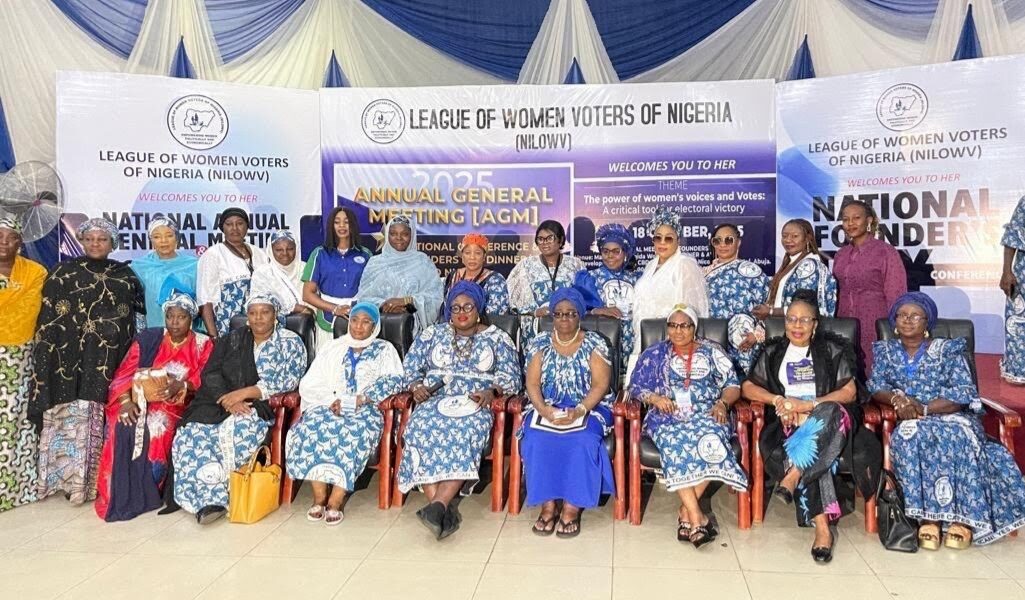
The demands were made at NILOWV’s 30th anniversary All-Women Conference in Abuja, where women leaders, policymakers and gender advocates examined the challenges limiting women’s participation in political leadership and decision-making.
Founder and Chairperson of NILOWV’s Board of Trustees, Dr Esther Uduehi, said Nigeria needed deliberate legislative and political reforms to address the persistent underrepresentation of women in elected and appointive positions.
She identified constitutional reform, passage of the Reserved Seats for Women Bill and coordinated advocacy across the country’s six geopolitical zones as critical measures towards achieving more inclusive governance.
Uduehi maintained that women’s inclusion in leadership should not be treated as a favour but as a responsibility necessary for national development.
“Women’s inclusion is not a favour to women; it is a responsibility to Nigeria,” she said.
She also called on political parties to establish measurable targets for women’s nominations and leadership positions, stressing that existing commitments to gender equality must translate into practical opportunities for women seeking elective offices.
According to her, prohibitive nomination fees, exclusionary party structures and political intimidation remain significant obstacles confronting women aspiring to political leadership.
She advocated leadership development programmes to equip aspiring female politicians with skills in campaign management, fundraising, public speaking, digital communication, policymaking and electoral laws.
The NILOWV founder further called for mentorship networks connecting experienced women leaders with younger and emerging female politicians to strengthen women’s participation in the political process.
Delivering the keynote address, Founding Executive Director of the African Centre for Leadership, Strategy and Development, Dr Otive Igbuzor, said Nigeria could not achieve inclusive development while women remained marginalised in political decision-making.
Igbuzor highlighted the low representation of women in legislative institutions, citing analyses of candidate lists for the 2027 elections which he said put women’s share of candidates at approximately 9.7 per cent.
He advocated the passage of the Reserved Seats for Women Bill, which proposes the creation of 182 additional legislative seats for women across the country.
The proposed arrangement comprises 37 additional seats in the Senate, 37 in the House of Representatives and 108 across the 36 State Houses of Assembly.
He described the proposed legislation as a necessary intervention to address structural barriers preventing women from securing elective positions.
“The Reserved Seats for Women Bill is not a concession to women. It is a necessary democratic correction,” he said.
Igbuzor also called for reforms in political party candidate selection processes, campaign financing and leadership recruitment, alongside sustained investment in women’s political development.
He stressed the need to protect women politicians against violence and intimidation, improve voter education and establish accountability mechanisms to monitor progress in women’s political representation.
President of NILOWV, Irene Awunah-Ikyegh, urged women to move beyond anniversary celebrations and strengthen grassroots mobilisation ahead of the 2027 elections.
She said women needed to engage political parties early enough to influence decisions on candidates, party leadership and policies affecting their participation in governance.
“As we mark 30 years, I invite us all to move from celebration to renewed commitment,” she said.
Awunah-Ikyegh emphasised the importance of political education, leadership development, mentorship and documentation of women’s contributions to national development.
She also called on women to organise their numerical strength into meaningful political influence, noting that their participation should extend beyond voting and supporting candidates to actively shaping decisions that affect society.
The conference also highlighted the importance of women’s economic independence as a foundation for effective political participation.
Uduehi advocated affordable credit facilities, access to land and markets, technology, agricultural support and improved opportunities for women-owned businesses.
She called on the government to measure the impact of economic empowerment programmes through indicators such as women’s income, asset ownership, job creation and business survival.
The NILOWV founder also stressed the need for safer learning environments, improved access to education for girls, opportunities in science, technology, engineering and mathematics, and stronger responses to gender-based violence and political intimidation.
She further advocated gender-responsive budgeting, reliable gender-disaggregated data and stronger partnerships involving government institutions, traditional and religious leaders, organised labour, the private sector and development partners.
The conference comes amid continuing concerns over women’s limited representation in Nigeria’s political institutions.
Figures cited by Uduehi showed that women occupied only four of the 109 seats in the Senate and 16 of the 360 seats in the House of Representatives following the 2023 general elections.
The figures underscore the longstanding gap between women’s participation in the electoral process and their representation in legislative decision-making.
Participants maintained that addressing the imbalance would require more than policy declarations, urging political institutions to adopt practical measures capable of improving women’s access to political opportunities.
They called for sustained advocacy, adequate funding, institutional accountability and legislative reforms to ensure that women have greater opportunities to participate in shaping Nigeria’s political and development agenda.
As the country prepares for the 2027 general elections, NILOWV said the priority should be to translate decades of advocacy for women’s empowerment into measurable progress in political representation, economic independence and leadership.