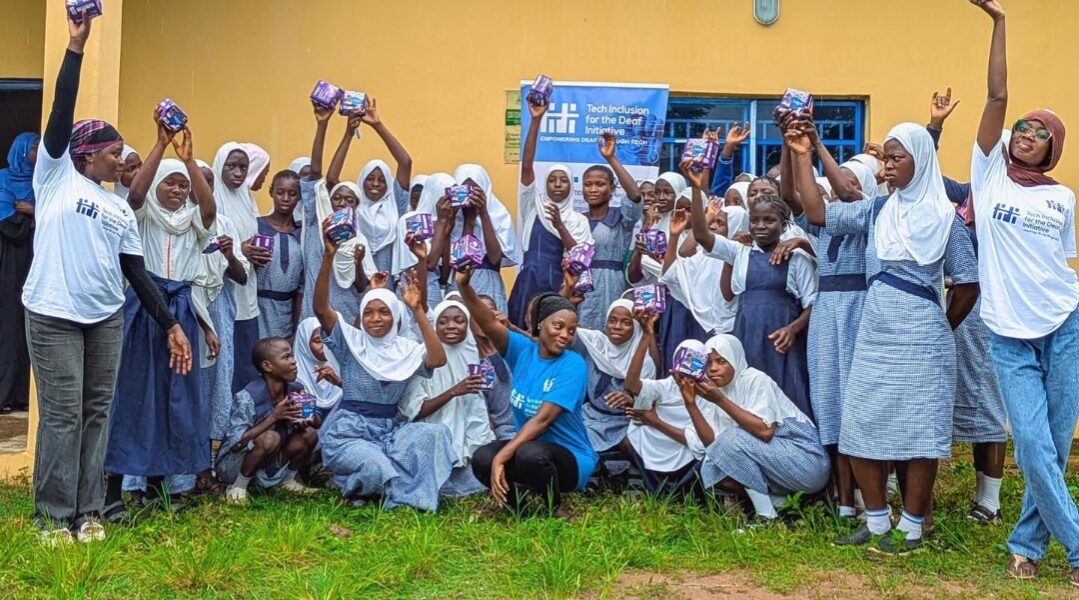
Five hearing-impaired Nigerian schoolgirls have developed an artificial intelligence-powered application designed to help students locate sanitary pad banks, request menstrual products and access menstrual health information.
The girls, who attend Government Secondary School, Kuje, Abuja, represented Nigeria as global finalists at the 2026 Technovation Girls World Summit in Bengaluru, India.
Their team, known as STRIM Girls, developed the application, called Saving Pad, to address challenges associated with accessing menstrual products, particularly for deaf girls and students with disabilities.
According to a statement from the Technology Beyond Disability Initiative, the team competed against thousands of teams from more than 160 countries before presenting its innovation at the global summit.
The five students are Adegbile Teniola Vivian, Sulaiman Maryam Adenike Isah, Moses Joy, Ukpapi Theresa Uzepi and Yusuf Ruth. The initiative mentored the team during the development of the project.
Saving Pad is designed with an interactive map to help users identify nearby sanitary pad banks, alongside a request system, period-tracking features and menstrual health education resources.
The platform also allows coordinators to monitor supplies and receive alerts when stocks run low. These features are intended to help organisations and donor agencies track distribution, assess demand and coordinate the restocking of sanitary pad banks.
The project has moved beyond the design stage, with a pilot programme launched in partnership with the Deaf Women Aloud Initiative across three special schools in Abuja.
The team plans to expand the programme to primary healthcare centres and vulnerable communities, although wider implementation will depend on the resources and partnerships available.
The innovation brings together menstrual health, disability inclusion and digital technology at a time when access to menstrual products remains an important consideration for girls’ school attendance, dignity and participation in education.
For deaf students and other learners with disabilities, accessing appropriate menstrual health information and support can require additional attention to communication and accessibility.
By combining information on product availability with a request mechanism, Saving Pad offers a potential way to connect students with existing sanitary pad banks and improve coordination among those responsible for supplying them.
The students’ achievement also demonstrates how young people can apply technology to problems they encounter in their communities, rather than treating innovation solely as an abstract technical exercise.
However, the app’s long-term impact will depend on the availability of sanitary products, the accuracy of information about pad banks, the protection of users’ personal data and the ability to sustain the service beyond its pilot phase.
Expanding the platform will also require continued collaboration with schools, healthcare providers, disability organisations and menstrual health advocates to ensure that the technology remains accessible and useful to the girls it is designed to serve.
The team’s work highlights the potential of inclusive technology to support menstrual health while placing girls with disabilities at the centre of solutions intended to improve their lives.
ENDS