Women with disabilities have called on the six Area Councils in the Federal Capital Territory (FCT) to create dedicated budget lines for disability-inclusive healthcare, saying the continued reliance on charity and ad hoc interventions is undermining their right to accessible and quality health services.
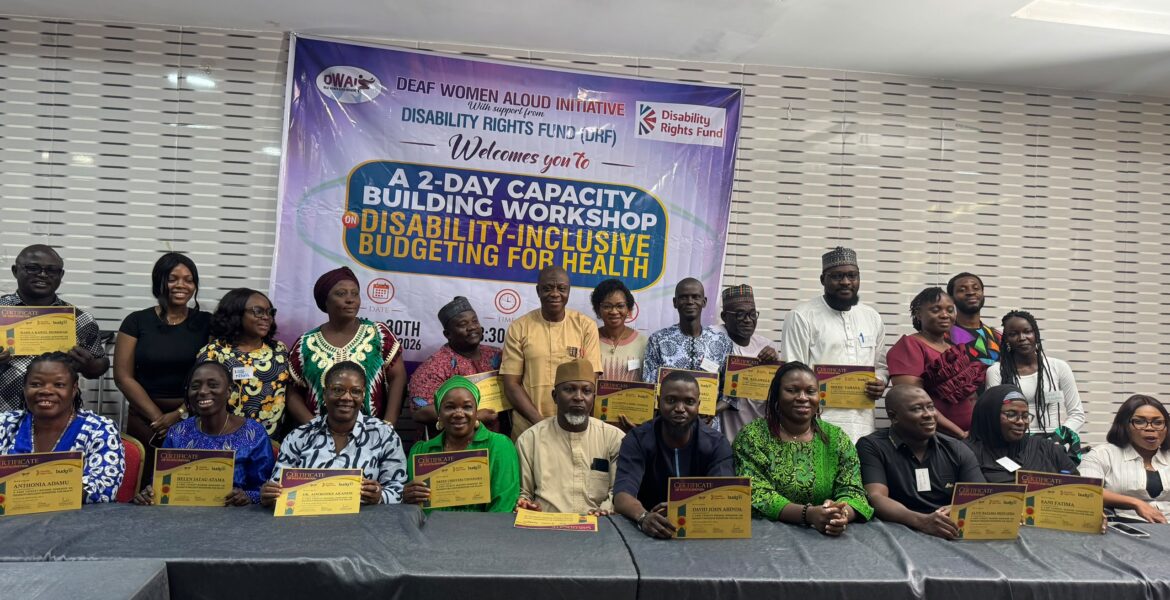
The Executive Director of Deaf Women Aloud Initiative (DWAI), Hellen Beyioku-Alase, made the call in Abuja during a two-day capacity-building workshop on disability-inclusive budgeting for health, supported by the Disability Rights Fund (DRF).
Beyioku-Alase said a baseline assessment conducted by DWAI across the six Area Councils revealed that none had a dedicated budget line specifically for disability inclusion in health, despite the significant barriers persons with disabilities face in accessing healthcare.
According to her, where persons with disabilities are considered in council interventions, support is often provided through charity, including donations of wheelchairs, cash and food, rather than through institutionalised public funding.
She said the situation must change from a charity-based approach to one that recognises persons with disabilities as rights holders whose needs should be deliberately reflected in government policies, plans and budgets.
“We want to move from charity to rights, from handouts to budget lines,” she said, stressing that disability inclusion must become part of the regular health planning and budgeting process.
Beyioku-Alase said the workshop was designed to move beyond discussions, with participating councils expected to develop model disability-inclusive budget lines and action plans that could be incorporated into their 2027 health budgets.
She noted that DWAI had already undertaken advocacy visits to five Area Councils—Gwagwalada, Abaji, Kwali, Kuje and Bwari—to engage political and health authorities on the need for inclusive budgeting.
She said some of the councils had made commitments, including Kuje, where the chairman pledged to implement key demands, while the Bwari Vice Chairman committed to developing a model accessible health facility.
She added that officials in Kwali, Gwagwalada and Abaji had also expressed willingness to strengthen disability inclusion in their health planning and budgeting.
The DWAI Executive Director stressed the importance of ensuring that persons with disabilities participate in decisions affecting them, noting that the principle of “nothing about us without us” should guide government interventions.
She also called for sustainable funding for sign language interpretation in health facilities, warning that depending on charity or donor support for such essential services could leave deaf women and other persons with communication disabilities without access to care when external funding ends.
Beyioku-Alase said professional sign language interpreters in healthcare require proper training, ethical standards, confidentiality safeguards and sustainable contracts, adding that basic sign language training for health workers should not be confused with the services of professional interpreters.
She further called for accessible health facilities, including ramps, appropriate equipment and communication support, noting that barriers within hospitals can contribute to delayed treatment and poor health outcomes.
The DWAI findings were further reinforced by its Monitoring and Evaluation Officer, Mr Collins Joseph, who said the assessment covered the offices of council chairmen, health departments and finance departments.
Joseph said the exercise involved key informant interviews and reviews of available budget documents, but revealed significant gaps in budget transparency and disability-specific financing.
He said some councils were reluctant to provide budget documents, while others had not published their budgets, despite the need for public access to information on how public resources are allocated.
According to the assessment, 60 per cent of the councils had no specific budget lines for disability, while there was no funding allocated for sign language interpreters. The assessment also found that a significant proportion of disability-related interventions remained charity-based.
Joseph warned against lumping persons with disabilities together with other groups under broad classifications such as “vulnerable groups,” arguing that their needs are diverse and require disaggregated planning and financing.
He said a deaf woman, a blind man and a person using a wheelchair may face different barriers in accessing healthcare and should not simply be treated as one undifferentiated category in government budgets.
Responding to the findings, the FCT Mandate Secretary in Health Services and Environment, Dr. Adedopeyin Olanrewaju, represented by Dr. Aderonke Adedeji, said the advocacy was timely as the FCT begins preparations for its 2027 Annual Operational Plan.
Adedeji said the FCT health sector was undergoing reforms aimed at changing existing practices and mainstreaming gender and disability across health programmes.
She said primary healthcare remained particularly important because most health interventions take place at that level, with the primary healthcare authorities of the six Area Councils operating under the FCT Primary Health Care Board.
According to her, disability inclusion must be reflected in the work of every programme officer rather than treated as the responsibility of a single unit.
She disclosed that the FCT had expanded its gender structures to accommodate disability inclusion, creating dedicated divisions to strengthen attention to the needs of persons with disabilities.
Adedeji also acknowledged gaps in the accessibility of primary healthcare facilities, recalling situations where pregnant women could not access health centres because of the absence of ramps.
She said the challenge extended beyond physical infrastructure, as some health workers also lacked adequate understanding of the needs of persons with disabilities.
The FCT health official called for sustained training of frontline health workers, including training in basic sign language and disability-sensitive healthcare delivery.
“This is about rights, not charity,” she said, emphasising the need to move from policy formulation to actual implementation.
She also raised concerns over poor implementation of health budgets, noting that some programmes implement less than five per cent of their approved budgets, with some recording implementation levels of below two or three per cent.
She said the situation made it necessary for advocates to push for effective utilisation of existing financing mechanisms rather than relying entirely on statutory allocations.
Adedeji identified the Basic Health Care Provision Fund (BHCPF) as one potential avenue through which disability-inclusive interventions could be strengthened at the primary healthcare level.
She urged disability advocates to engage community structures and decision-makers to ensure that the needs of persons with disabilities are incorporated into health financing and implementation plans.
The Programme Manager, Disability Rights Fund West Africa, Mr Theophilus Odaudu, said Nigeria had laws and policies recognising the rights of persons with disabilities, but warned that such provisions would remain largely on paper without corresponding budgetary commitments.
Odaudu commended DWAI for focusing its advocacy at the grassroots, noting that persons with disabilities who are often most marginalised live within communities where Area Councils have direct responsibility for implementing several public services.
He urged the councils to translate the commitments made at the workshop into concrete policies and budget allocations.
“A lot of the times we gather, we talk and we go, but nothing changes,” he said, stressing that the success of the workshop should ultimately be measured by changes in policies, budgets and services.
He called for continued collaboration among disability organisations, government authorities and other stakeholders to build an accessible and inclusive health system.
For DWAI, the demand is clear: disability inclusion must no longer depend on goodwill, donations or the priorities of individual office holders, but must be institutionalised through dedicated funding, accessible facilities and accountable public health systems.