As Nigeria continues to grapple with the low representation of women in elective positions, civil society organisations (CSOs) and development partners are weighing the implications of the proposed Electoral College model for the Women’s Special Seats Bill, with stakeholders seeking assurances that the new approach will genuinely expand women’s access to political power.
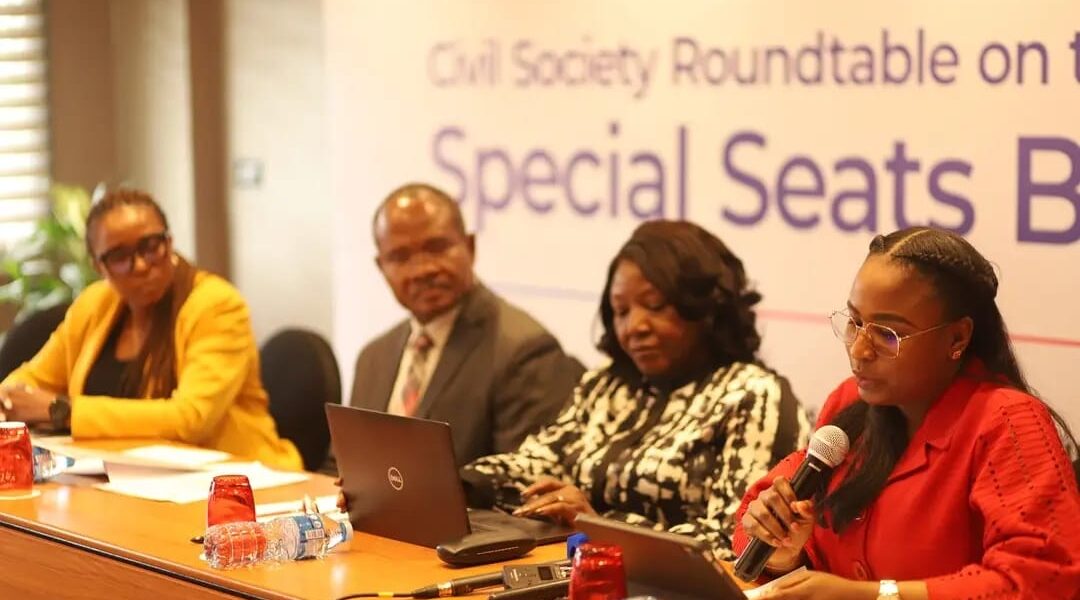
The stakeholders converged in Abuja at a high-level roundtable organised by the Policy and Legal Advocacy Centre (PLAC), with support from the European Union (EU), to examine the revised constitutional amendment proposal before the National Assembly and develop a common advocacy position ahead of further legislative engagements.
The proposed Women’s Special Seats Bill, which seeks to create additional legislative seats for women as a temporary affirmative action measure, was initially designed around direct elections. However, the latest proposal introduces an Electoral College system as the mechanism for selecting women who would occupy the additional seats.
The change has generated debate among gender advocates, with concerns raised over transparency, accountability and the possibility of political influence, even as stakeholders acknowledge that the model could provide a pathway towards increasing women’s presence in Nigeria’s legislatures.
Speaking at the roundtable, Executive Director of PLAC and Lead Technical Adviser to the House of Representatives Committee on Constitution Review, Mr. Clement Nwankwo, said the Electoral College proposal emerged from engagements with lawmakers, particularly members of the Senate who had expressed reservations about the direct election model.
He explained that the revised approach was introduced as a compromise aimed at securing wider support for the constitutional amendment while preserving its core objective of improving women’s representation.
“The proposal is something that a lot of us are not familiar with, and many of us are not entirely comfortable with it. But it is something we need to discuss as stakeholders to determine whether it is the kind of compromise that can still deliver the objective we all seek,” Nwankwo said.
Under the proposed framework, women interested in the special seats would be nominated by political parties and elected by an Electoral College made up of governors, senators, members of the House of Representatives and elected local government officials from each geopolitical zone.
Nwankwo, however, acknowledged concerns that the process could be influenced by dominant political parties, especially in regions where one party controls most elected positions.
“If a geopolitical zone is largely controlled by one political party, you can already anticipate the likely outcome. Those are some of the issues we must interrogate as stakeholders,” he said.
He disclosed that the proposed amendment provides for 12 additional seats for women in the Senate, 37 seats in the House of Representatives, including one for the Federal Capital Territory, and 108 additional seats across State Houses of Assembly.
The bill also retains a 16-year sunset clause, making the special arrangement temporary unless renewed through another constitutional process.
While acknowledging the concerns surrounding the Electoral College model, stakeholders stressed that the bigger issue remains Nigeria’s persistent gender imbalance in political leadership.
According to them, women continue to face structural, financial and institutional barriers that limit their participation in elections despite accounting for nearly half of the country’s population.
Providing a legislative perspective, Ms. Joy Akut, Special Adviser to the Deputy Speaker on Youth and Women Affairs and constitutional review consultant with the National Assembly, urged stakeholders not to lose sight of the purpose of the proposed legislation.
“What has changed is the mechanism, not the mission,” she said.
“The objective of the Special Seats Bill remains exactly the same: to expand women’s representation through a temporary constitutional measure that strengthens our democracy.”
Akut argued that while concerns around transparency and accountability were legitimate, similar challenges already existed within Nigeria’s political system.
“We only need to look at what happened during recent party primaries to know that these concerns are not unique to the Electoral College model. The challenge before us is to ensure that whatever model is adopted works effectively,” she added.
She maintained that increasing women’s representation was not merely about gender equality but about improving governance outcomes.
“Nigeria cannot continue to exclude half of its population from legislative decision-making while expecting the best governance outcomes. This is about strengthening our democracy,” Akut said.
Offering a comparative analysis, Director-General of the Nigerian Institute of Social and Economic Research (NISER) and former National Commissioner of the Independent National Electoral Commission (INEC), Professor Antonia Okoosi-Simbine, said Electoral College systems had been used successfully in several countries, including the United States, India, Germany and Pakistan.
She explained that the credibility of such systems depended largely on the structure and composition of the electoral body.
“The composition of the body is a very powerful design lever. How we constitute the Electoral College will largely determine whether Nigerians perceive it as transparent, representative and credible,” Okoosi-Simbine said.
She pointed to countries such as Rwanda, Uganda, Morocco and Mauritania, where deliberate affirmative action measures have improved women’s representation in parliament.
“If Nigeria decides to adopt the Electoral College route, we are not doing something unusual. The important thing is ensuring that it is carefully designed to achieve the desired outcome,” she said.
However, she stressed the need for public education, noting that many Nigerians were unfamiliar with the Electoral College concept and its implications.
During the discussions, participants raised concerns about ensuring that women elected through the proposed system remain accountable to citizens rather than political leaders who may influence their emergence.
They called for strong legal safeguards to prevent political godfatherism, party dominance and elite capture from undermining the objective of the reform.
Responding to the concerns, Nwankwo said many operational details could be addressed through amendments to the Electoral Act if the constitutional amendment receives approval.
“Our responsibility is to interrogate this proposal, identify the gaps and make recommendations that strengthen the final legislation,” he said.
Programme Manager at PLAC, Nkiru Uzodi, said the advocacy would continue beyond the current constitutional amendment process, noting that achieving meaningful representation for women requires sustained engagement.
She said the roundtable was organised to harmonise civil society positions before engaging lawmakers during the National Assembly Open Week.
“We are looking at the emerging proposal, discussing engagement strategies ahead of the National Assembly Open Week and sustaining the momentum behind this bill because women’s representation in our legislature remains extremely low,” Uzodi said.
She described the campaign for women’s inclusion as a long-term struggle.
“This is a marathon, not a sprint. We have been advocating for this through previous assemblies and we are not going to give up,” she added.
As the National Assembly prepares to revisit the constitutional reform proposals, stakeholders say the success of the Women’s Special Seats Bill will depend not only on creating additional seats for women but on ensuring that the process used to fill those seats is transparent, credible and capable of delivering genuine political inclusion.