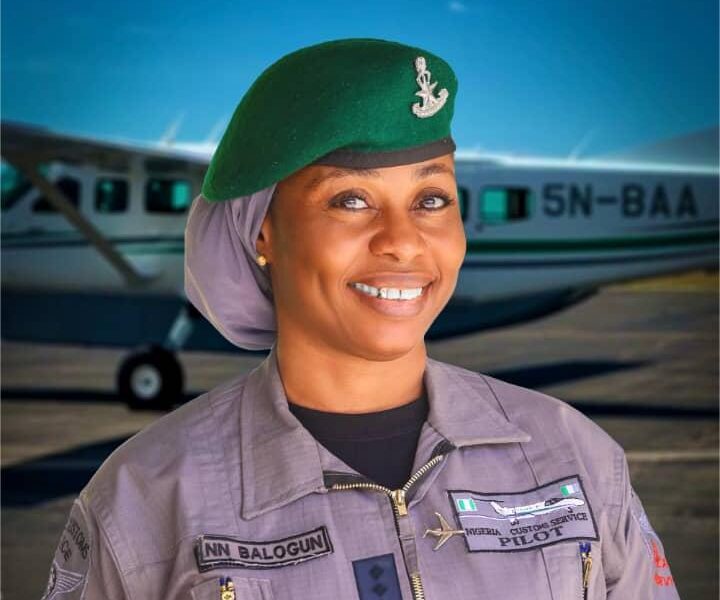
As the first female pilot of the Nigeria Customs Service (NCS), Olanike Nafisat Balogun has carved her name into a space once considered inaccessible to women, redefining both the Airwing’s trajectory and the possibilities for female officers in uniformed service. When she steps into the cockpit, she carries more than flight instruments and mission protocols, she carries history.
Balogun holds a historic distinction as the first female pilot of the Nigeria Customs Service (NCS). In a sector where women were, for decades, largely confined to cabin crew and administrative roles, her ascent to the flight deck represents more than career advancement; it marks a structural shift within one of Nigeria’s most strategic paramilitary agencies.
From Cabin Crew to Command
Born in Kaduna and a native of Odo-Otin in Osun State, Balogun joined the NCS in 2002 as a Customs Assistant. Her early years in the Service were spent in the Airwing Unit as cabin crew, a position that placed her close to aviation operations but still distant from the cockpit controls.
Rather than settle into the predictable trajectory available to many women in uniformed services at the time, she pursued further training. She earned an Advanced Diploma in Air Ticketing and Cabin Services before obtaining a master’s degree in public administration from Ahmadu Bello University, equipping herself not only with technical aviation knowledge but also with administrative and leadership expertise.
Her defining leap came when she secured pilot certification at the Flying Academy in Miami, Florida, sponsored by the NCS. The qualification positioned her as the first female pilot in the Service’s history, a milestone that quietly disrupted a male-dominated tradition.
Flying in a Complex Industry
Nigeria’s aviation sector contributes an estimated $2.5 billion to the nation’s GDP and supports more than 216,000 jobs. With 31 airports and over one million scheduled passenger seats as of December 2025, the country remains Africa’s fifth-largest airline market. Yet it is an ecosystem fraught with operational constraints, infrastructure gaps, fluctuating passenger volumes, and high capital demands.
Within this landscape, the role of the NCS Airwing is critical. It supports surveillance, anti-smuggling operations, logistics, and national security mandates. For Balogun, piloting in this context is not about commercial routes or passenger satisfaction ratings, it is about strategic enforcement and public service.
Colleagues credit her with strengthening the operational effectiveness of the Airwing, contributing to mission readiness and technical discipline. Her choice to remain within the NCS, despite potentially more lucrative offers in commercial aviation, underscores a commitment to service over spectacle.
A Broader Shift in Aviation Leadership
Balogun’s rise mirrors a broader transformation across Nigeria’s aviation ecosystem. Female pilots now command Boeing 737s and Dreamliners; women occupy executive roles in airlines and aviation agencies; regulators increasingly shape policy at national and continental levels.
Still, representation remains uneven, particularly in technical and paramilitary aviation roles. The flight deck, historically symbolic of male authority, is only gradually becoming more inclusive.
Balogun’s story therefore carries both symbolic and practical weight. It signals to young Nigerians, especially women, that entry barriers, while real, are not insurmountable.
Mentorship Beyond the Uniform
Beyond active flying duties, she mentors aspiring aviators, offering guidance on training pathways, discipline, and resilience. For many young women considering aviation careers, her journey provides a tangible reference point: a woman who entered through one door, trained deliberately, and rose through persistence rather than privilege.
As Nigeria marks Women’s Month, her career serves as a reminder that inclusion in high-skill sectors is not merely a social ideal but an economic imperative. In industries that demand precision, innovation, and strategic foresight, diversity strengthens institutional capacity.
At cruising altitude, there is little room for hesitation. Decisions must be clear, swift, and informed. Olanike Nafisat Balogun embodies that clarity, navigating not only the skies but the shifting terrain of gender representation in one of Nigeria’s most vital sectors.
In doing so, she is not just flying aircraft. She is redrawing the horizon.