…MD assures priority in tractor allocation under national mechanisation programme
The Managing Director and Chief Executive Officer of the Bank of Agriculture (BOA), Ayodeji Oludare Sotinrin, has assured that female-led groups will be prioritized in the allocation of tractors under the ongoing federal government’s new National Agricultural Mechanization Programme (NAMP), citing evidence that they are among the most reliable operators in the sector.
Speaking during a press briefing on Monday in Abuja ahead of the distribution ceremony of 2,000 tractors and other agricultural equipment along the Abuja–Lokoja Expressway in Gwagwalada, Sotinrin said evidence shows that women are among the most reliable operators in mechanized agriculture.
“One of the largest applicants for this programme is a women’s mechanisation group, and frankly, we prefer to support women-led service providers. They are not trying to outsmart the system. They know how to manage assets and make them last.”
He added that women understand the value of productive assets because “this is what brings daily bread,” stressing that data from previous agricultural interventions indicates that women-run mechanisation programmes are among the most successful in Nigeria.
“Why would I deliberately give tractors to people who may dismantle and sell the parts, when I know that women have shown stronger asset discipline?” he asked.
The BOA boss dismissed suggestions that women lack access to information about the programme, insisting that female participation has been robust. However, he acknowledged structural barriers and assured that eligibility criteria have been designed to accommodate youth- and women-led mechanisation service providers (MSPs).
Under the scheme, applicants must demonstrate capacity to service at least 600 hectares annually, the operational benchmark that makes tractor use commercially viable. But Sotinrin noted that flexibility would be applied in assessing women and youth operators, particularly those operating at smaller scales but with strong growth potential.
“We are not just looking at size. We are looking at sustainability, capacity and commitment. Women will not be sidelined in this process,” he assured.
From Distribution to Developmental Financing
Beyond gender inclusion, Sotinrin said the mechanisation initiative marks a shift from politically driven tractor distribution to a structured, financially sustainable model anchored on service provision.
“We are not distributing tractors as charity, we are selling them at subsidized rates, with structured repayment over three to five years. This is not free money.”
He disclosed that over 80,000 applications were received for the 2,000 available slots, underscoring what he described as Nigerians’ habitual expectation of government handouts.
“In the past, tractors were shared. And when you share 2,000 tractors to 2,000 individuals, what happens to the remaining millions of farmers?” he queried. “This programme is designed to benefit up to 1.2 million farmers annually through mechanisation service providers.”
According to him, each tractor is expected to service approximately 600 hectares yearly. With 2,000 tractors deployed, the programme aims to mechanize at least 1.2 million hectares. a significant scale-up compared to past interventions.
He explained that tractors would not be given directly to individual smallholder farmers, many of whom cultivate one hectare or less, but to structured service providers who will offer mechanisation services across multiple farms.
“A farmer with one hectare cannot repay a N60 million tractor. It is not possible,” he said. “But a mechanisation service provider operating across hundreds of hectares can generate enough revenue to sustain operations and repay the loan.”
Maintenance and Accountability
Responding to concerns about sustainability and maintenance, Sotinrin revealed that 36 mobile service trucks — one per state — have been deployed as the first line of defence for routine servicing.
In addition, President Bola Ahmed Tinubu has approved the construction of seven large mechanisation service centres nationwide, strategically located to serve clusters of states, including a reinforced presence in the North-East due to security considerations.
“These centres are not just for the 2,000 tractors; they are part of a long-term sustainability framework for mechanization in Nigeria,” he said.
All tractors under the programme will come with two years of comprehensive servicing and will be digitally tracked to monitor usage, maintenance schedules and compliance. Operators will also undergo mandatory training before deployment.
“We are building BOA 2.0,” Sotinrin told journalists. “This is not business as usual. We have thought through the first, second and third layers of implementation. This is taxpayers’ money. Accountability must be seen,” he added.
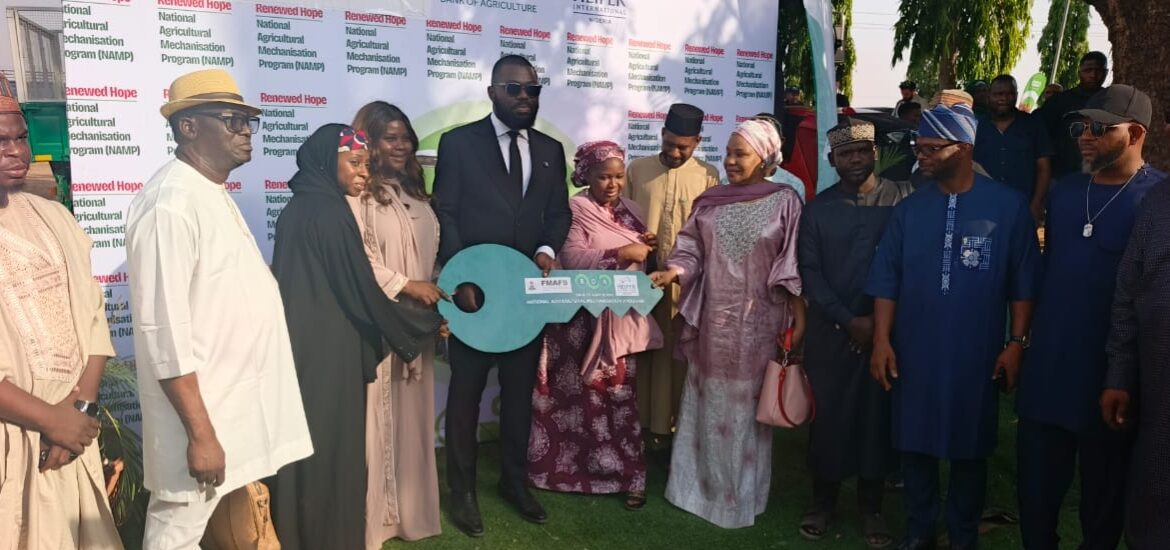
The distribution ceremony, held at the National Agricultural Seeds Council grounds in Gwagwalada, marks what officials describe as the largest mechanization rollout of its kind in Nigeria and a cornerstone of the government’s food security strategy.
For Sotinrin, however, the measure of success will not be the number of tractors deployed, but the number of hectares cultivated, and the number of smallholder farmers, especially women, whose productivity and incomes are ultimately transformed.
He stressed that women understand the economic value of productive assets because they are directly linked to household sustenance, adding that data from previous agricultural interventions show that women-run mechanisation initiatives rank among the most successful in the country.