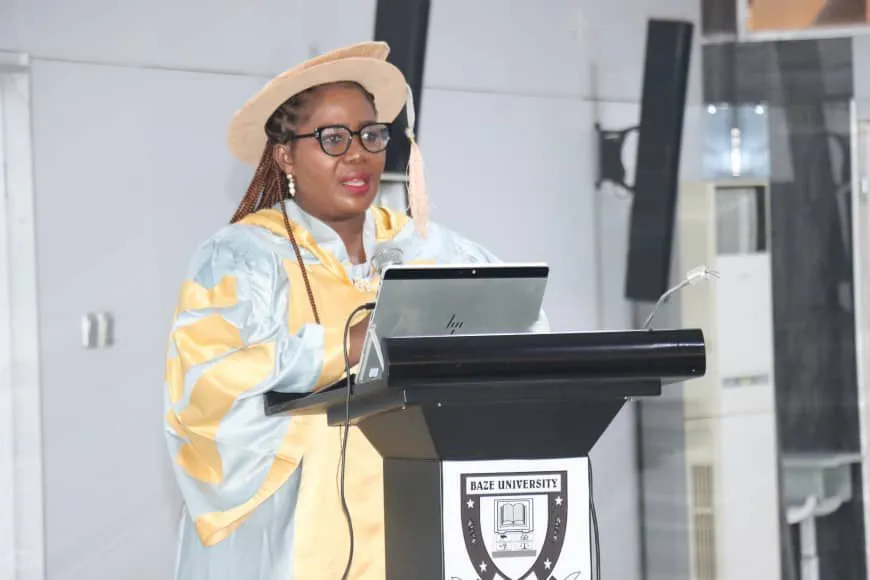
The Professor of Lifespan Developmental Psychology at Baze University, Agatha Ogechi Ogwo, has expressed concerns that despite the visible strides Nigerian women continue to make in academics, business, politics, and family life, a significant portion of their capacity remains untapped.
Prof. Ogwo made this known on Tuesday, during the university’s 6th Inaugural Lecture held in Abuja. In her lecture titled “Unleashing Her Potential: The Place of Self-Efficacy, Mentoring, and Personality in the Psychology of Women Empowerment,” she urged institutions and society to pay closer attention to the psychological dimensions of empowerment.
She noted a recurring pattern among female graduates: many excel during their university years yet gradually retreat from leadership spaces and ambitious career pursuits after school. She explained that this shift is less about marriage itself and more about the deeply rooted belief that marriage represents the ultimate achievement for women, thereby reducing education to a temporary phase instead of a lifelong asset.
According to her, empowerment must be viewed as both an internal and collective journey. She identified self-efficacy, mentoring, and personality development as critical pillars that sustain women’s growth. Confidence in one’s abilities, access to guided mentorship, and the cultivation of resilient character traits, she stressed, are indispensable in helping women translate potential into long-term impact.
To address these gaps, the psychology professor recommended the introduction of structured mentorship frameworks within universities. She also advocated for embedding courses on emotional intelligence, leadership skills, personality development, and self-belief into academic programmes. Additionally, she proposed the establishment of gender empowerment centres within tertiary institutions to provide institutional support for women’s advancement.
Beyond the university environment, Prof. Ogwo encouraged the strengthening of grassroots mentorship networks that connect accomplished professional women with girls in rural and semi-urban communities, ensuring that empowerment efforts are inclusive and far-reaching.
In concluding her lecture, she underscored the need to move beyond conventional notions of educating women. True empowerment, she said, involves equipping women psychologically shifting them from dependency to autonomy, and from unrealized promise to purposeful contribution.
Earlier in the programme, the Vice-Chancellor of Baze University, Prof. Jamila Shu’ara, welcomed attendees to the sixth edition of the institution’s inaugural lecture series. The Deputy Vice-Chancellor (Academics), Prof. Osita Agbu, described the lecture as both timely and aligned with ongoing national discussions around girl-child education and women’s leadership.
The event formally closed with a vote of thanks delivered by the University Registrar, Prof. Abiodun Adeniyi.