
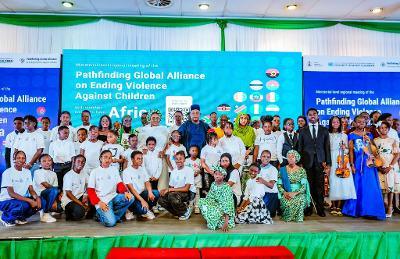
President Bola Ahmed Tinubu has emphasized the importance of the welfare, health and protection of Nigerian children, signaling a deliberate shift toward human capital development as a cornerstone of national growth.
Tinubu made the commitment during the launch of the National Plan of Action on Ending Violence Against Children (2024–2030) in Abuja. as part of its commitment to the protection, health, education and nutrition of Nigerian children, with coordinated interventions spanning policy reform, service delivery, and direct humanitarian support for targeted sustainable sectoral impacts aimed at ensuring that Nigerian children not only survive, but thrive in safe, inclusive and supportive environments.
The President has described with emphasis on preventive healthcare, nutrition, social protection and stronger institutions to safeguard children from violence, neglect and exploitation, saying these are critical to Nigeria’s long-term stability and prosperity.
He assured of his administration’s renewed focus on child health and nutrition, recognising their direct link to learning outcomes, productivity and economic development.
Through expanded immunisation drives, malaria prevention programmes, nutrition interventions and school feeding initiatives, the Federal Government is working to reduce preventable child deaths and improve early childhood development.
He underscored this commitment, particularly through the Nutrition 774 Programme, designed to reach children in every local government area of the country, noting that proper nutrition is essential for children to perform academically, develop creatively and grow into healthy adults.
“No child in Nigeria should go hungry,” the President has said.
The programme complements the National Home-Grown School Feeding Scheme, which targets improved school attendance, cognitive development and community-based food systems.
Beyond health, the President has taken a firm stance on child protection, describing violence against children as both a moral failure and a development setback.
This resolve was underscored on 8 May 2025, when President Tinubu launched the National Plan of Action on Ending Violence Against Children (2024–2030) in Abuja. The Plan provides a multi-sectoral framework for prevention, enforcement, survivor support and accountability at both national and sub-national levels.
Represented at the event by Vice President Kashim Shettima, the President stressed that laws alone are insufficient without enforcement and institutional resolve.
“Legislation does not protect the vulnerable by itself. It is the will behind those laws, and the systems that enforce them, that make the real difference,” he said.
Nigeria’s existing legal instruments, including the Child Rights Act and the Violence Against Persons (Prohibition) Act, he noted, must be matched with action, vigilance and political will.
The Federal Government further introduced a National Policy on Safety, Security and Violence-Free Schools, alongside operational guidelines for school administrators.
Teachers’ training curricula now incorporate social-emotional learning and child safeguarding, while targeted interventions for Almajiri and out-of-school children are being strengthened to ensure inclusive access to education.
President Tinubu has also announced plans to deploy social protection tools such as a Universal Child Grant, and to finalise a National Child Wellbeing Index to measure progress, identify gaps and promote accountability across sectors.