…Reveals Mali as New Destination for Trafficked Nigerian Victims
…65 Trafficked Nasarawa Girls Yet to Be Accounted for; Only Seven Rescued
The National Agency for the Prohibition of Trafficking in Persons (NAPTIP) has raised fresh concerns over the rising wave of human trafficking in Nigeria, revealing that Mali has emerged as a major new destination for trafficked Nigerian victims, particularly women and girls.
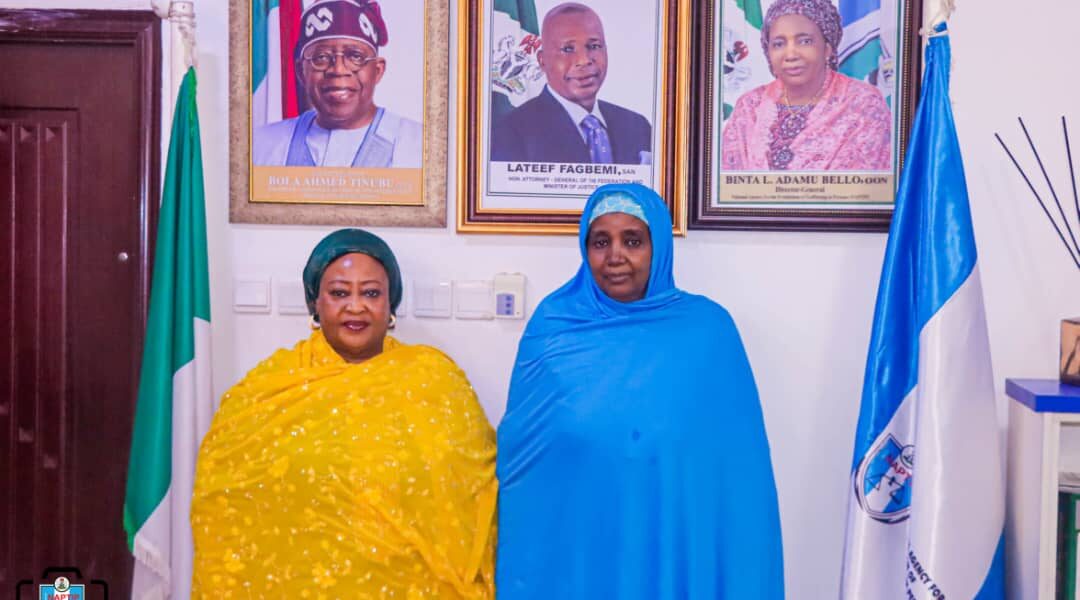
Director-General of NAPTIP, Binta Lami Adamu Bello, disclosed this during a courtesy visit by the Nigeria Association of Women Journalists (NAWOJ) ahead of the maiden Women in Security Summit and Awards (WINSEC) 2026 in Abuja.
Describing human trafficking as one of Nigeria’s most persistent security and humanitarian challenges, Bello said the agency now receives distress reports on a daily basis, with cases involving both domestic and transnational trafficking continuing to rise.
“Every blessed day we receive stories of trafficking. Throughout last week, the trend has been Mali, Mali, Mali. We also have cases involving Burkina Faso, Ghana and Côte d’Ivoire. It is happening every day.”
The NAPTIP boss explained that while international trafficking remains a major concern, the agency is equally worried about the growing incidence of trafficking within Nigeria.
She revealed that 65 girls from Nasarawa State were trafficked, with only seven rescued so far, while efforts continue to locate and recover the remaining victims.
“The saddest part is that trafficking has gone beyond the normal pattern. It is now both national and transnational,” she said.
Bello recalled receiving a distress call at about 6:30 a.m. from a woman seeking help to rescue a relative who had been trafficked to Mali, noting that such emergency calls have become a regular occurrence.
She explained that although families often demand immediate intervention, rescuing victims from foreign countries requires established diplomatic and legal procedures involving the governments of the affected countries.
The Director-General also highlighted recent rescue operations involving dozens of Nigerian women deceived with promises of lucrative jobs abroad.
She recalled how NAPTIP officials received 46 young Nigerian women rescued from trafficking networks linked to Afghanistan, Pakistan, Oman and Iraq, many of whom said they had no idea they were being lured into exploitation until they became victims.
According to Bello, women and girls remain the primary targets of trafficking syndicates, making public awareness and early reporting critical to prevention.
She warned that traffickers are often people within communities and urged Nigerians to remain vigilant.
“If we disclose the identities of some of those behind these crimes, many people will be shocked,” she said, stressing the need for stronger community vigilance and collaboration.
Calling on journalists to intensify public enlightenment campaigns, Bello said the media remains one of the strongest tools for preventing trafficking and protecting vulnerable persons.
“As journalists, you are storytellers and factual tellers of events. We need your support to educate communities, expose trafficking networks and help reduce this menace to the barest minimum,” she said.
Although she acknowledged that completely eradicating trafficking may not be possible, Bello maintained that sustained advocacy, stronger partnerships and increased public awareness would significantly reduce the crime.
The NAPTIP Director-General also pledged the agency’s support for the forthcoming Women in Security Summit and Awards (WINSEC) 2026, assuring NAWOJ of its commitment to collaborate on initiatives that promote women’s safety and combat trafficking.
Despite funding challenges facing government agencies, Bello said NAPTIP would continue to support programmes that protect vulnerable populations and strengthen national security.
“My doors are open for you, not because you are journalists, but because you are women,” she told the delegation, directing relevant departments within the agency to begin immediate coordination with NAWOJ ahead of the summit.
Earlier, NAWOJ National Chairperson, Comrade Aisha Ibrahim, commended NAPTIP for its renewed drive against human trafficking, child abuse, sexual exploitation and other forms of gender-based violence.
She said the media has a critical role in exposing trafficking networks, amplifying survivors’ voices and educating communities on safe migration and child protection.
Aisha formally invited Bello to participate in the inaugural WINSEC Summit scheduled for August 5, 2026, noting that the agency’s experience in combating trafficking would enrich national conversations on human security.
She also proposed a long-term partnership between NAWOJ and NAPTIP on media capacity building, public awareness campaigns, ethical reporting, child protection and advocacy against trafficking in persons.
The collaboration, she said, would strengthen efforts to protect women and girls while mobilising citizens to play a more active role in preventing human trafficking across Nigeria.