
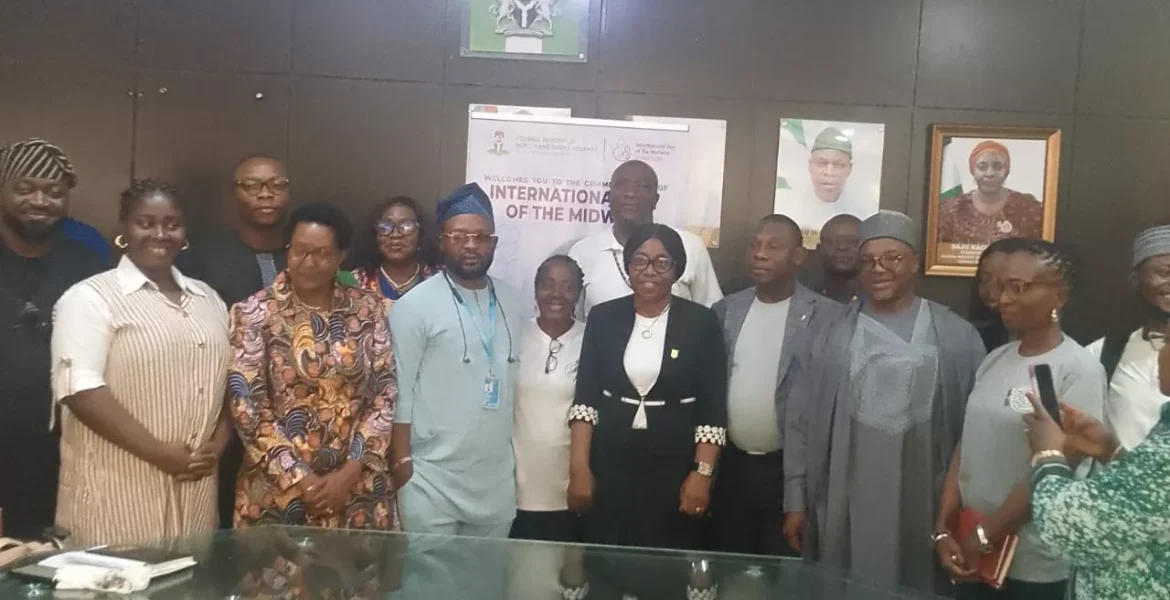
The Federal Government has reaffirmed its commitment to advancing Sexual and Reproductive Health and Rights (SRHR) through strategic investments in midwifery, maternal healthcare, and newborn survival programmes aimed at reducing preventable deaths among women and children in Nigeria.
Speaking during a ministerial press briefing to commemorate the 2026 International Day of the Midwife in Abuja, the Coordinating Minister of Health and Social Welfare, Muhammad Ali Pate, said the government was implementing deliberate and targeted interventions to strengthen maternal and reproductive healthcare services nationwide.
Represented by the Director of Hospital Services, Dr. Abisola Adegoke, the minister noted that midwives remain central to the delivery of maternal and newborn healthcare, particularly in rural and underserved communities where access to skilled healthcare services is limited.
According to him, no healthcare system can achieve improved maternal and child health outcomes without a strong and adequately trained midwifery workforce.
As part of efforts to strengthen reproductive and maternal healthcare systems, the government launched the Nigeria Strategic Directions for Nursing and Midwifery 2025–2030, described as a comprehensive national roadmap to improve education, workforce capacity, leadership, and service delivery for nurses and midwives.
The minister disclosed that the strategy includes expanding training institutions, increasing admission quotas for midwifery programmes, modernising education standards to align with global best practices, and ensuring equitable deployment of midwives across the country.
He added that the Federal Government was also prioritising continuous professional development and competency-based training for midwives to improve maternal and newborn survival rates.
Professor Pate further revealed that the government was targeting high-burden communities through the Maternal Mortality Reduction Innovation Initiative (MAMII), aimed at ensuring that no woman dies during childbirth.
He identified the Basic Emergency Obstetric and Newborn Care (BEmONC) and Comprehensive Emergency Obstetric and Newborn Care (CEmONC) programmes as additional interventions supporting reproductive, maternal, and newborn healthcare delivery across Nigeria.
The minister described this year’s International Day of the Midwife theme, “One Million More Midwives,” as timely, stressing that scaling up the midwifery workforce is critical to improving reproductive health outcomes and reducing maternal mortality.
He said the government was partnering with stakeholders to ensure that midwives are equipped with adequate tools, supplies, and conducive work environments while also improving welfare, motivation, and retention.
The Federal Government also pledged to strengthen primary healthcare systems, expand digital health solutions, improve working conditions for healthcare workers, and deepen community engagement to encourage skilled birth attendance.
In her remarks, the Permanent Secretary, Federal Ministry of Health and Social Welfare, Daju Kachollom, represented by Dr. Okpako Okpikpi, said midwives remain at the heart of Nigeria’s healthcare system, providing essential services to women and newborns before, during, and after childbirth.
She reaffirmed the ministry’s commitment to supporting midwives through improved training, investments in healthcare infrastructure, and policies aimed at strengthening maternal and child healthcare services nationwide.
The government said the initiatives reflect its broader commitment to achieving universal access to quality reproductive, maternal, newborn, and child healthcare services as part of efforts to improve national health outcomes and protect the rights and wellbeing of women and children.