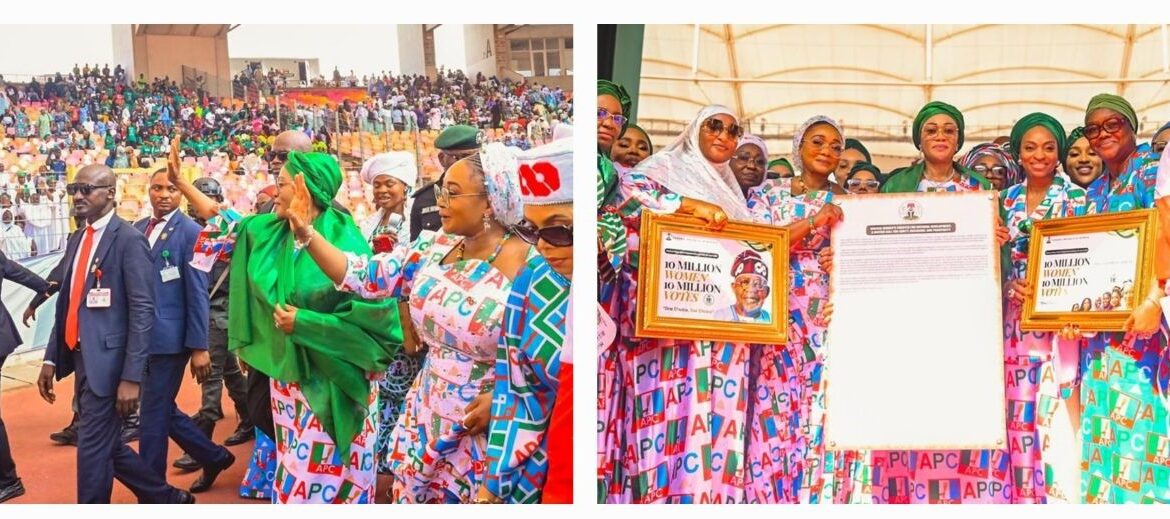
Over 10 million Nigerian women has unveiled the Nigeria Women’s Charter for National Development, demanding far-reaching constitutional, economic and governance reforms aimed at securing equity, inclusion and prosperity for women across the country.
The Charter was presented at the National Flag-Off of the Power of 10 Million Women Mega Empowerment and Rally 2026, drawing participants from all 774 local government areas under the theme, “One Voice, One Movement, One Choice.”
Described by its proponents as both a social contract and policy compass, the Charter represents one of the most coordinated national demands by Nigerian women since the country’s return to democratic rule in 1999.
Declaring an end to decades of exclusion, the women said despite their contributions to nation-building, they remain structurally sidelined from power and opportunity.
“For twenty-six years, the promise of parity has been deferred, but the era of silent endurance has finally ended,” the Charter stated.
The women demanded:
- 35 percent affirmative action in appointive and elective offices;
- At least two female governors nationwide;
- One female senator per state;
- Three female state assembly members per state;
- 50/50 gender parity in cabinet appointments, boards and heads of government agencies.
The Charter also calls for an overhaul of political party structures to eliminate systemic barriers to women’s participation through equitable campaign financing and transparent candidate selection processes.
Political observers say the proposals could significantly reshape Nigeria’s male-dominated political space if implemented.
Economic Inclusion at Forefront
The women also pushed for sweeping economic reforms to address poverty, financial exclusion and limited enterprise support.
Their demands include:
- A five-year zero-interest credit facility for women entrepreneurs;
- 35 percent of public investment for women-led initiatives in agriculture, health, education and technology;
- Full enforcement of affirmative procurement policies for women-owned businesses;
- Creation of a Fund for Women and Technology to boost STEM education and digital literacy.
The Charter noted that women continue to face systemic barriers to accessing credit, land ownership and public procurement opportunities despite dominating Nigeria’s informal economy.
Push for 19% Budget Allocation
In one of its strongest fiscal demands, the Charter seeks 19 percent of the national budget for the Ministry of Women Affairs, Families and Children to support gender-responsive programmes nationwide.
The proposed funding would cover:
- Child care and safeguarding directorates;
- Women protection structures;
- Expanded empowerment and social protection programmes across all 774 LGAs.
Broader Demands on Health, Justice and Family Welfare
The Charter also seeks reforms in social welfare and justice, including:
- Integration of mental health and reproductive healthcare into primary healthcare;
- Enactment of a Care Economy Law to recognise unpaid domestic and caregiving labour;
- Full implementation of the State of Emergency on Sexual and Gender-Based Violence;
- Establishment of Family Courts and an Equal Opportunity Commission;
- Declaration of a Decade of the Family to strengthen household support systems.
Government Backs Women’s Agenda
Presenting the Charter to First Lady Senator Oluremi Tinubu for onward transmission to President Bola Ahmed Tinubu, Minister of Women Affairs and Social Development, Hajia Imaan Sulaiman Ibrahim, described the document as the collective mandate of Nigerian women.
“This Charter represents the collective voice, aspirations, and strategic expectations of Nigerian women. It is not merely a document; it is a bold declaration of our place in the future of this nation,” she said.
The minister said the Charter aligns with the Federal Government’s Renewed Hope Agenda, praising the administration for reforms affecting women, children and vulnerable groups.
She added that Nigerian women are now “organized, mobilized and ready to shape the future of the nation.”
First Lady Promises Delivery to President
Receiving the document, First Lady Senator Oluremi Tinubu pledged to transmit the Charter to President Tinubu and support its implementation.
“I have received your Charter, and I assure you that I will deliver it to Mr. President. This is our Charter, and we will see it to fruition,” she said.
She commended Nigerian women for their resilience, particularly during recent economic reforms, and urged them to remain committed to national development.
Turning Point in Women’s Political Advocacy
Observers say the unveiling of the Charter may mark a watershed moment in Nigeria’s women’s movement, consolidating decades of advocacy into a unified national agenda.
By combining previous women’s demands and policy proposals into one framework, the Charter positions women as a coordinated electoral and developmental bloc rather than fragmented advocacy groups.
The Charter concludes with a declaration that:
“A Nigeria that works for women is a Nigeria that works for all.”
With women holding less than 10 percent of elective positions nationwide despite comprising nearly half the population, analysts say the Charter’s demands could intensify pressure for reforms ahead of future political cycles.