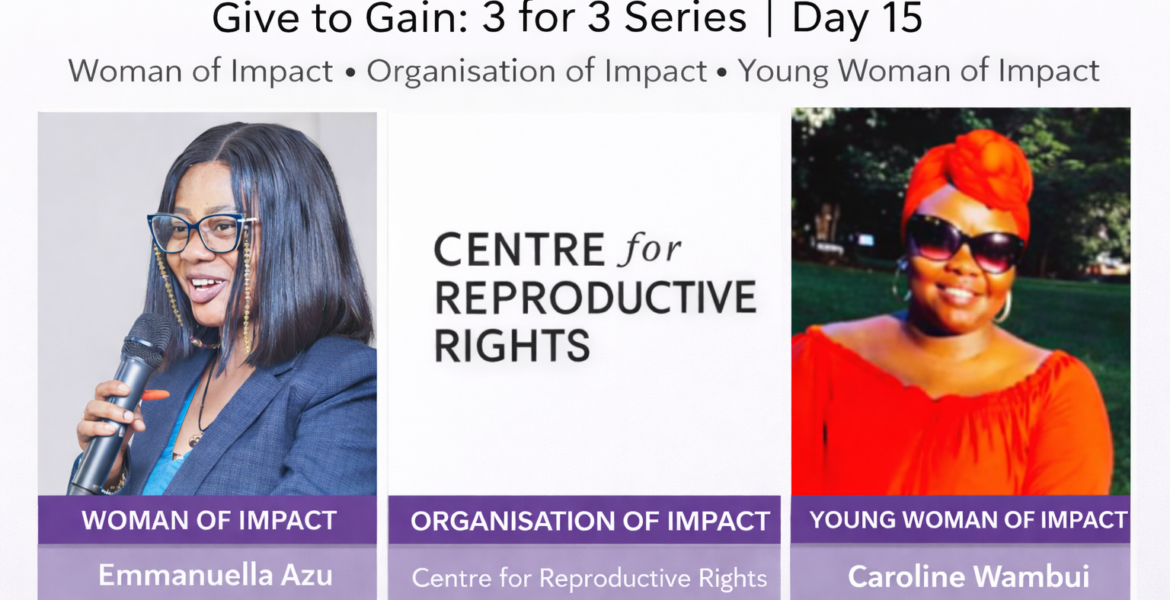
Day 15 highlights the power of legal advocacy in advancing women’s rights. We celebrate Emmanuella Azu, the global legal leadership of the Center for Reproductive Rights, and the reproductive justice advocacy of Caroline Wambui in Africa.
Woman of Impact
Emmanuella Azu — Nigeria
“The law must serve as a tool for justice and protection, especially for women and girls whose rights are often ignored.” — Emmanuella Azu
Emmanuella Azu is a Nigerian lawyer and gender justice advocate whose work focuses on strengthening legal protections for women and girls. As Head of Legal and Partnerships and now leading the expansion portfolio at the Women Advocates Research and Documentation Centre, she plays a key role in advancing legal advocacy, institutional partnerships, and regional expansion of the organisation’s gender justice initiatives.
Through her legal expertise, Azu has contributed to policy advocacy, strategic litigation, and programmes aimed at improving accountability around sexual and gender-based violence, reproductive rights, and women’s access to justice. Her work also involves building collaborations with civil society organisations, development partners, and policy institutions to strengthen protections for women across Nigeria and West Africa.
By combining legal practice with feminist advocacy, she represents a new generation of professionals using the law as a powerful instrument to advance gender equality and social justice.
Organisation of Impact
Center for Reproductive Rights
“Reproductive rights are fundamental human rights that must be protected by law.” — Center for Reproductive Rights
The Center for Reproductive Rights is one of the world’s leading legal organisations dedicated to advancing reproductive freedom as a fundamental human right. Through strategic litigation, policy advocacy, and legal research, the organisation works to ensure that governments uphold women’s reproductive health and rights.
Across Africa, the Center has supported landmark legal cases and policy reforms that strengthen access to safe maternal healthcare, family planning, and protections against harmful practices. By partnering with civil society organisations, legal practitioners, and regional bodies, it has helped shape legal frameworks that safeguard the dignity and autonomy of women and girls.
Its work continues to influence constitutional reforms, public health policies, and international human rights standards, reinforcing the principle that reproductive justice is central to gender equality and sustainable development.
Young Woman of Impact
Caroline Wambui — Kenya
“Access to reproductive health care is not a privilege, it is a fundamental human right that governments must protect.” — Caroline Wambui
Caroline Wambui is among a new generation of African feminists using the law to advance reproductive justice and gender equality. As an advocate with the Center for Reproductive Rights, she works on legal and policy strategies aimed at strengthening access to reproductive health services and protecting the rights of women and girls across Kenya and the African region.
Her work focuses on engaging courts, policymakers, and civil society to ensure that national laws and policies align with constitutional protections and international human rights standards. Wambui has also contributed to advocacy efforts addressing maternal health, safe abortion access under the law, and accountability for violations of reproductive rights.
Through legal advocacy and policy engagement, she represents a new wave of young African feminists advancing justice, dignity, and autonomy for women across the continent.