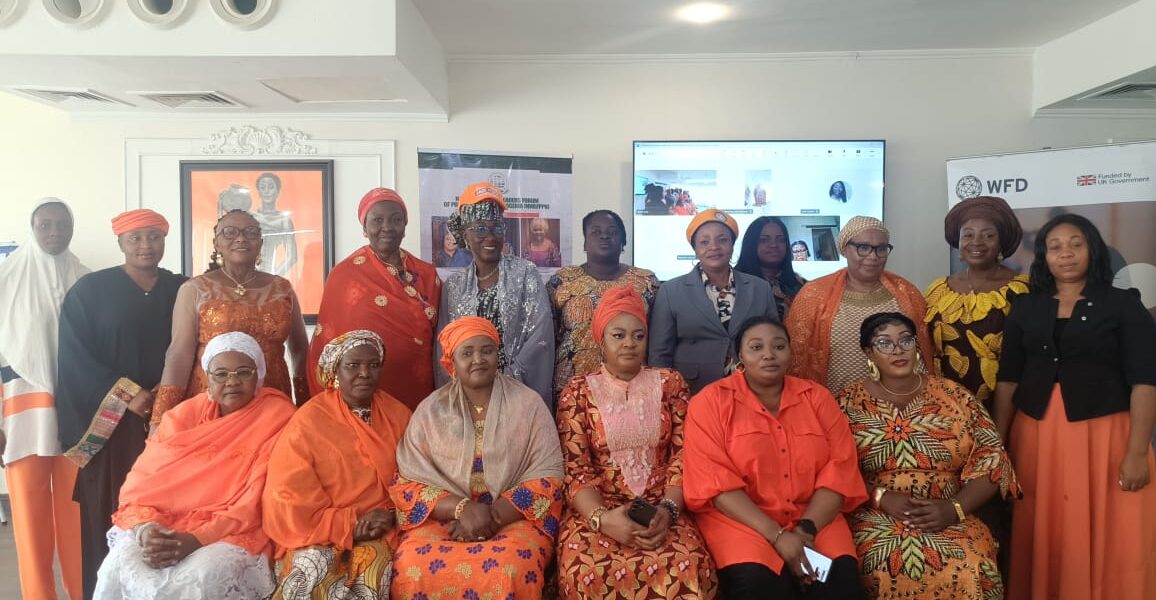
As the global 16 Days of Activism Against Gender-Based Violence winds down, the National Women Leaders Forum of Political Parties in Nigeria (NWLFPPN) has issued a strong call for immediate national action to curb the escalating digital violence targeted at women in politics.
The call was made during a Commemorative Dialogue for the 16 Days of Activism Against Gender-Based Violence and International Human Rights Day, 2025, convened to advance feminist leadership and end digital attacks on politically active women.
As contained in a communiqué signed by its President, Hon. Amina Darasimi Bryhm, and Publicity Secretary, Hajiya Sa’adatu Abdullahi, the Forum warned that digital platforms have become “weaponized spaces,” increasingly used to silence, shame, and exclude women from political participation.
In the communiqué, the Forum expressed “deep concern over the increasing use of cyberbullying, online sexual harassment, coordinated disinformation, cyber stalking, doxxing, threats, and hate speech as tools to intimidate and silence women in active politics.”
The women noted that although digital technologies hold tremendous potential for democratic engagement, they have simultaneously become “dangerous arenas where gender-based violence thrives.”
They stressed that these abuses undermine human rights, deepen gender inequalities, and threaten Nigeria’s democratic integrity.
The communiqué further emphasized:
“There is an urgent need to create safe, inclusive digital and physical spaces where women can exercise their political voice without fear of harassment or retaliation.”
Key Demands and Resolutions
Following deliberations, the NWLFPPN resolved to take the following critical actions, including advocacy for national laws that explicitly address digital violence against women in politics, while also demanding for stricter accountability and improved content moderation from social media platforms operating in Nigeria.
The adoption of feminist, gender-sensitive party policies that prohibit all forms of gender-based political violence, including online abuse, establish confidential reporting and protection systems within political parties and
Institutionalise mandatory training on feminist leadership and digital safety.
A strengthened women’s digital security skills and resilience, while creating intra-party mentoring systems for women leaders, as well as establish robust legal, psychosocial, and rapid-response support for survivors of digital or physical political violence.
The communique further demanded cross-party solidarity to encourage women across all political parties to publicly condemn any attack on a female political actor, and hold regular dialogues to share strategies, track trends in digital violence, and coordinate collective advocacy.
The communique also called on political party leadership to prioritise and finance the implementation of these resolutions, especially the National Assembly to enforce law and judiciary to strengthen and enforce laws against online harassment.
It also called on social media and tech companies to invest in local moderation, improve accountability systems, and protect women online and Civil Society, Media to document abuses and hold all actors accountable.
“Ending digital violence against women in politics is not just a women’s issue; it is a prerequisite for Nigeria’s democratic future,” the women leaders reiterated.
Speaking during the event, NWLFPPN President Hon. Amina Darasimi Bryhm underscored the urgency of confronting digital violence head-on, she warned that silence worsens the crisis and urged women who have suffered abuse to come forward.
According to her, “This issue has become a barrier to women’s political participation and inclusion. If women remain silent because of one negative experience, who is going to speak for us?”
“If women are afraid to step out, our numbers will continue to dwindle. We are not discouraged—we are encouraged to speak for others who cannot speak.”
Experts Highlight Rising Online Abuse
Dr. Stanley Ukpai, Director of Programmes at the Development Research and Projects Centre (DRPC), described technology-facilitated gender-based violence (TFGBV) as a rapidly growing threat since Nigeria’s digital boom began in 2010.
He explained:
“Women with higher visibility face more attacks; sexualized slurs, identity-based abuse, fake news, insults, and derogatory messages. Political party codes of conduct remain gender-blind, and existing laws do not fully recognize technology-facilitated GBV.”
Ukpai noted that the first national baseline came from the NDHS, revealing that 2% of women aged 15–49 have experienced some form of online gender-based violence, an underestimation due to limited data collection.
He called for policy updates, platform moderation, and stronger regulation that would discourage anonymous attacks.
Earlier, the Country Director at the Westminster Foundation for Democracy (WFD), Adebowale Olorunmola, represented by Programmes Manager Sola Folayan, said the Foundation remains committed to strengthening political parties and advancing women’s leadership.
“We want political parties not only to speak about inclusion but to practice it. That is why we have been supporting the National Women Leaders Forum to promote and advance gender issues within party structures,” she said.
A Turning Point for Women in Politics
The communiqué concluded with a pledge from all National Women Leaders to continue coordinated advocacy, track progress, and reconvene to assess impact.
“Today, we have moved beyond dialogue to a pact for action,” the Forum stated.